


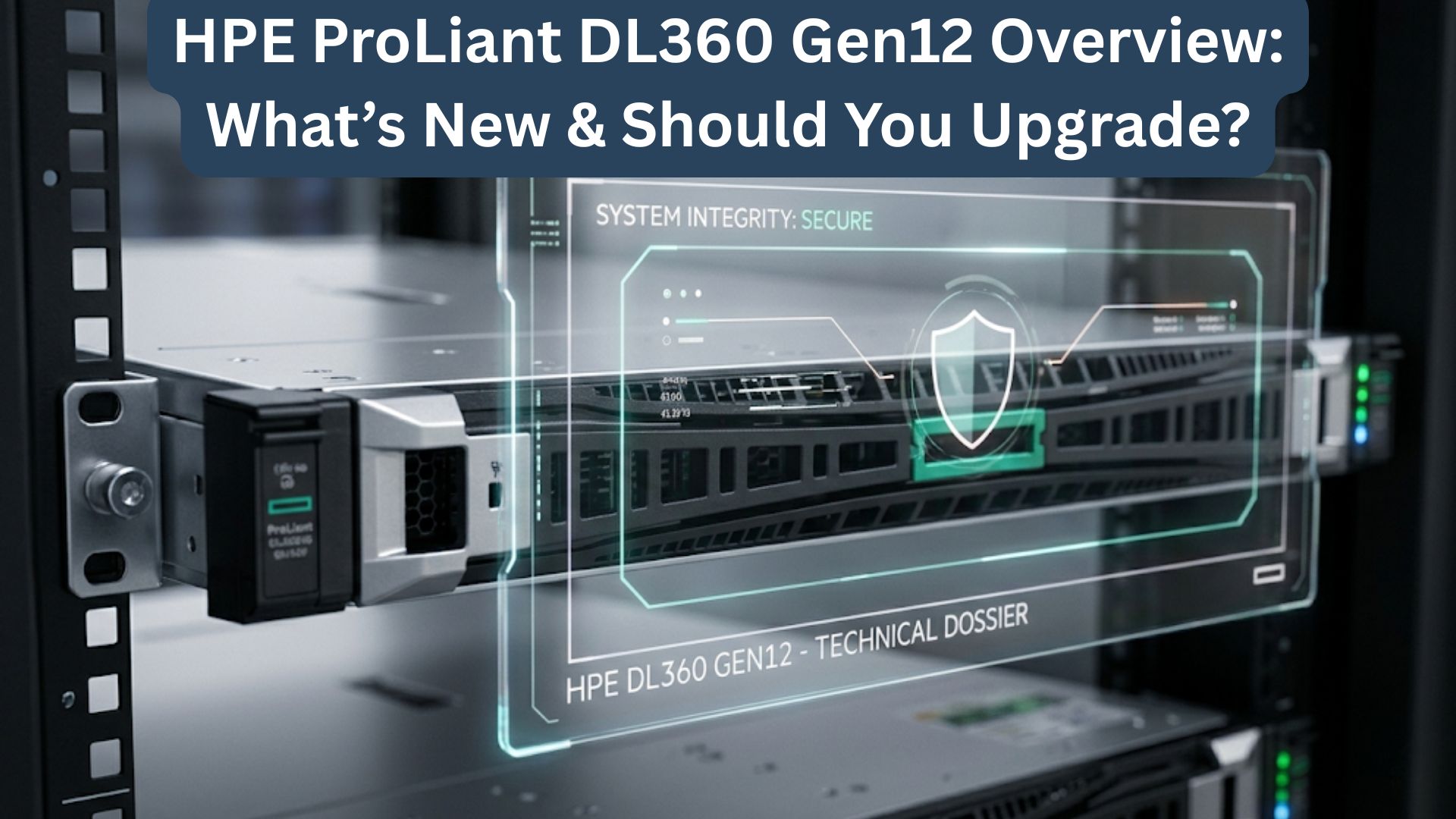
The demand for AI-ready, high-density infrastructure is accelerating as organizations adopt advanced analytics, edge computing, and hybrid cloud strategies. Data centers are no longer just storage hubs. They are becoming performance-driven environments that support diverse, compute-intensive workloads.
The HPE ProLiant DL360 Gen12 represents the next evolution of the DL360 series, introducing major improvements in processing power, memory bandwidth, and thermal efficiency. It is designed to meet the growing needs of modern enterprises that require scalable and future-ready infrastructure.
In environments integrating GPU acceleration, such as AI compute platforms, Gen12 servers play a critical role in coordinating compute and data workloads efficiently.
Key Takeaways:
- Supports Intel Xeon 6 processors with up to 144 cores per CPU for high-density compute workloads
- Up to 8 TB DDR5 memory at 6400 MT/s enables high-bandwidth, data-intensive processing
- PCIe Gen5, EDSFF NVMe, and GPU support improve I/O performance and AI inference capability
- Advanced cooling options, including liquid cooling, improve efficiency and support high-performance workloads
Overview of HPE ProLiant DL360 Gen12
What is the DL360 Gen12 Server
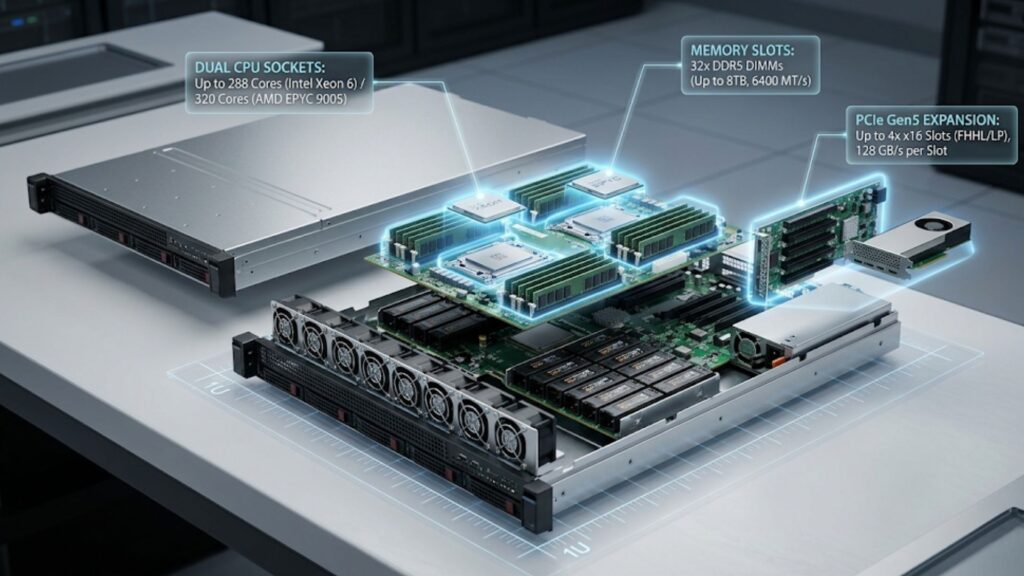
The DL360 Gen12 is a 1U rack server built for high-density deployments. It is designed to deliver improved compute performance, faster memory speeds, and enhanced scalability compared to previous generations.
It supports next-generation processors, storage, and networking technologies, making it suitable for both traditional enterprise applications and emerging AI workloads.
Key Specifications Snapshot
| Component | Specification |
| Form Factor | 1U Rack Server |
| CPU Platform | Intel Xeon 6 |
| Max Cores | Up to 144 cores per CPU |
| Memory | DDR5 |
| Max Memory | Up to 8 TB |
| Expansion | PCIe Gen5 |
| Storage | NVMe, EDSFF, SFF/LFF |
| Management | HPE iLO 7 |
Target Workloads and Enterprise Use Cases
The DL360 Gen12 is designed for:
- AI inference and edge workloads
- Virtualization and container platforms
- Database and analytics systems
- Hybrid and multi-cloud environments
Organizations building scalable enterprise infrastructure systems often rely on servers like the DL360 Gen12 to support diverse workloads.
What’s New in Gen12: Key Innovations
Intel Xeon 6 Processor Architecture (Up to 144 Cores)
The Gen12 platform introduces Intel Xeon 6 processors, offering up to 144 cores per CPU, a significant increase compared to the 60-core limit in Gen11 systems.
This improvement enables higher workload consolidation and better performance in parallel processing environments.
The performance improvements between Gen11 and Gen12 are summarized below:
| Component | Gen11 | Gen12 |
| CPU Cores | Up to 60 | Up to 144 |
| Memory Speed | DDR4 ~3200 MT/s | DDR5 up to 6400 MT/s |
| Memory Capacity | Up to 4 TB | Up to 8 TB |
| Bandwidth | Moderate | High |
DDR5 Memory and Increased Bandwidth
DDR5 memory delivers significantly higher bandwidth and improved efficiency compared to DDR4, supporting data-intensive and latency-sensitive workloads. This enhances performance for memory-intensive applications such as analytics and AI inference.
PCIe Gen5 and Next-Gen I/O Performance
PCIe Gen5 provides faster data transfer speeds, enabling improved communication between storage, networking, and compute components.
This is essential for modern workloads that require low latency and high throughput.
GPU Support for AI and Edge Workloads
The DL360 Gen12 supports GPU acceleration, making it suitable for AI inference and edge computing scenarios.
It complements GPU deployments such as AI GPU deployments, where balanced CPU and GPU performance is critical.
Architecture and System Design Analysis
1U High-Density Design Evolution
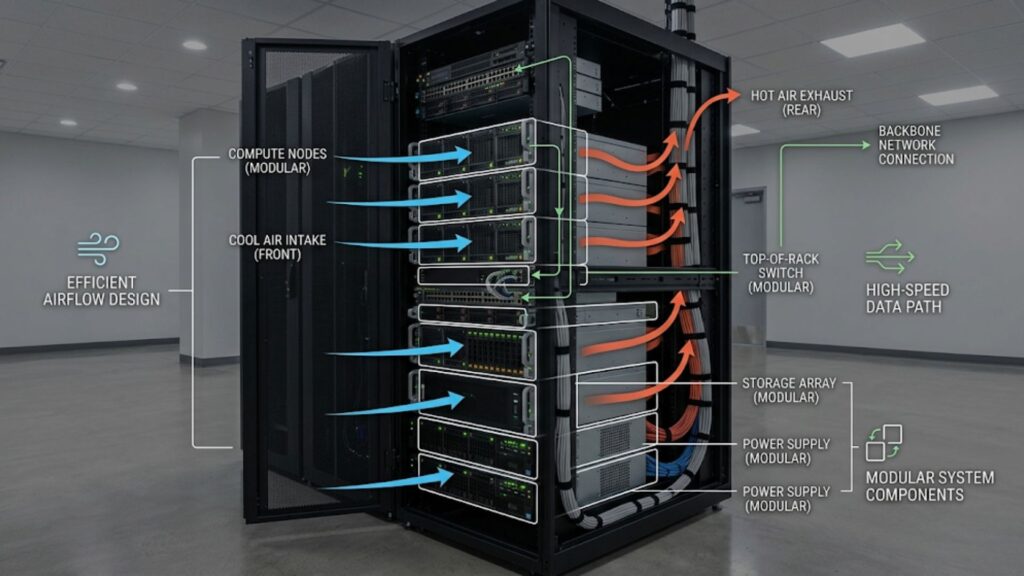
The DL360 Gen12 continues the 1U design philosophy but improves internal architecture for better performance density. It allows organizations to maximize compute power without increasing rack space.
Modular and Scalable Infrastructure
The system is designed with modular components, allowing flexible configuration and future upgrades. This supports evolving workload requirements and long-term infrastructure planning.
Integration with Hybrid and Multi-Cloud Environments
The DL360 Gen12 integrates with modern cloud platforms and enterprise systems. It supports hybrid deployments, enabling seamless workload movement across environments.
It supports up to 8 TB DDR5 memory at 6400 MT/s, enabling high-performance computing and large-scale data processing.
Advanced Cooling and Thermal Innovation
Air Cooling vs High-Performance Fan Kits
Standard air cooling is enhanced with high-performance fan kits, ensuring consistent thermal management under load.
Closed-Loop Liquid Cooling System
Closed-loop liquid cooling provides improved heat dissipation for high-performance configurations.
Direct Liquid Cooling (DLC) and Efficiency Gains
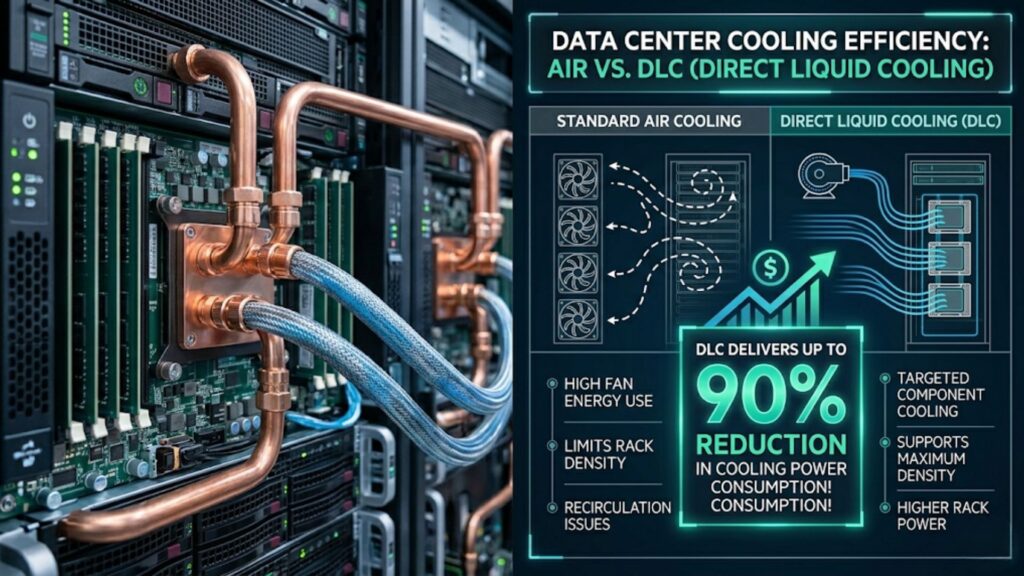
Direct Liquid Cooling (DLC) significantly improves thermal efficiency and reduces energy consumption.
| Cooling Type | Description | Use Case |
| Air Cooling | Standard fan-based cooling | General workloads |
| High-Performance Fans | Enhanced airflow | High-density compute |
| Closed-Loop Liquid | Self-contained liquid cooling | Performance workloads |
| Direct Liquid Cooling (DLC) | Liquid-to-chip cooling | AI / HPC environments |
In advanced deployments, DLC can achieve up to 90% reduction in cooling power consumption, making it suitable for energy-conscious data centers. This aligns with evolving data center cooling strategies focused on efficiency and sustainability.
Storage Architecture and Flexibility
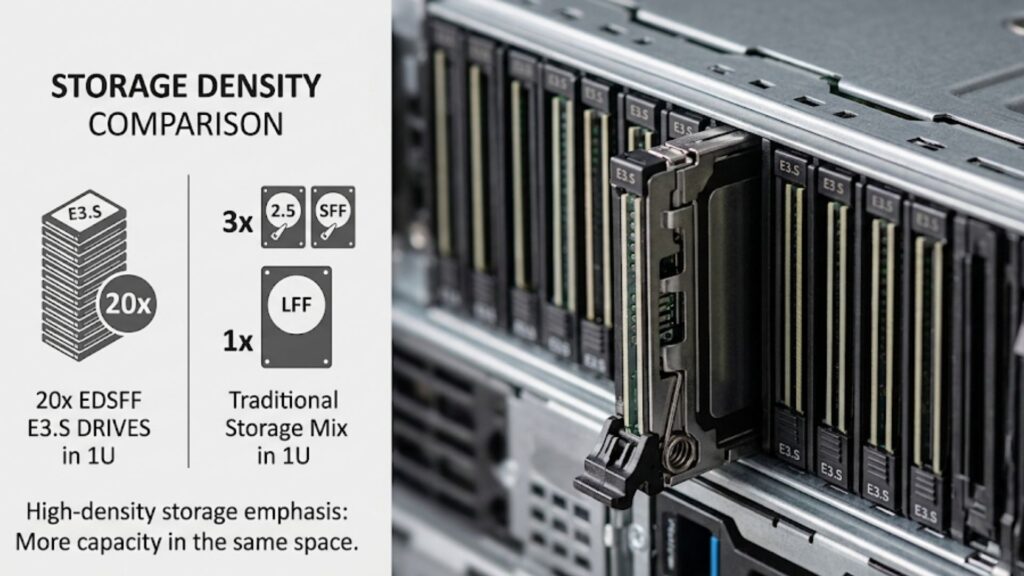
EDSFF E3.S NVMe Storage Expansion (Up to 20 Drives)
The DL360 Gen12 supports EDSFF E3.S NVMe drives, enabling high-density storage configurations with up to 20 drives.
SFF and LFF Configurations
Flexible storage options include SFF and LFF configurations, allowing organizations to choose between performance and capacity.
Boot Optimization with NS204i-u V2
The NS204i-u V2 boot device improves system reliability and simplifies OS deployment.
| Storage Type | Configuration | Use Case |
| EDSFF E3.S NVMe | Up to 20 drives | High-performance workloads |
| SFF | Flexible SSD/HDD mix | Balanced workloads |
| LFF | High capacity drives | Storage-heavy applications |
| NS204i-u V2 | Boot device | OS reliability |
This storage flexibility aligns with modern data architectures that prioritize speed, scalability, and workload adaptability.
Expansion, Networking, and GPU Acceleration
PCIe Gen5 and OCP 3.0 Capabilities
PCIe Gen5 and OCP 3.0 provide high-speed expansion and networking capabilities, supporting advanced workloads.
High-Speed Networking Integration
The server supports high-bandwidth networking, enabling efficient data transfer across systems.
GPU Support for AI Inference (e.g., NVIDIA L4)
GPU support enables AI inference workloads, particularly in edge environments where latency is critical.
Management, Security, and Reliability
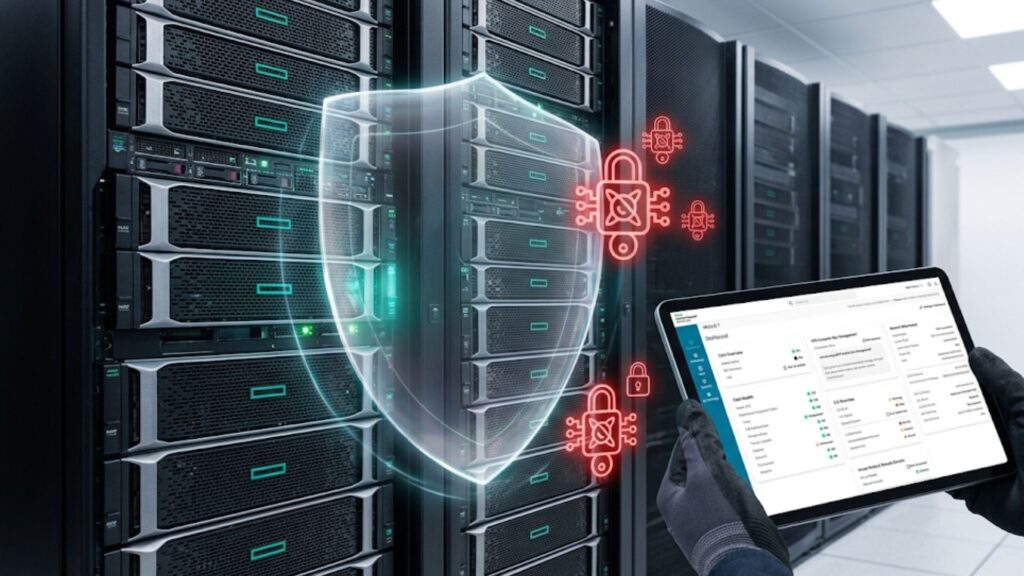
HPE iLO 7 and Next-Gen Management
HPE iLO 7 introduces improved remote management capabilities, allowing efficient monitoring and control.
Silicon Root of Trust and Quantum-Resistant Security
Enhanced security features protect firmware and system integrity, addressing evolving cybersecurity threats.
Automated Lifecycle Management
Automation tools simplify deployment, monitoring, and updates across server fleets.
DL360 Gen12 vs Gen11: Detailed Comparison
CPU and Performance Improvements
Gen12 delivers significantly higher core counts and improved processing efficiency.
Memory and Bandwidth Advancements
DDR5 memory provides higher bandwidth compared to DDR4 used in Gen11.
Cooling and Efficiency Differences
Gen12 introduces advanced cooling options, including liquid cooling technologies.
Security and Management Evolution
Improved management tools and security features enhance operational efficiency and protection.
| Feature | DL360 Gen11 | DL360 Gen12 |
| CPU Architecture | Intel Xeon Scalable | Intel Xeon 6 |
| Max Cores per CPU | Up to 60 | Up to 144 |
| Memory Type | DDR4 | DDR5 |
| Max Memory | Up to 4 TB | Up to 8 TB |
| PCIe Version | Gen4 | Gen5 |
| Cooling | Air | Air + Liquid + DLC |
| Management | iLO 6 | iLO 7 |
AI Workload Positioning and Future-Ready Infrastructure
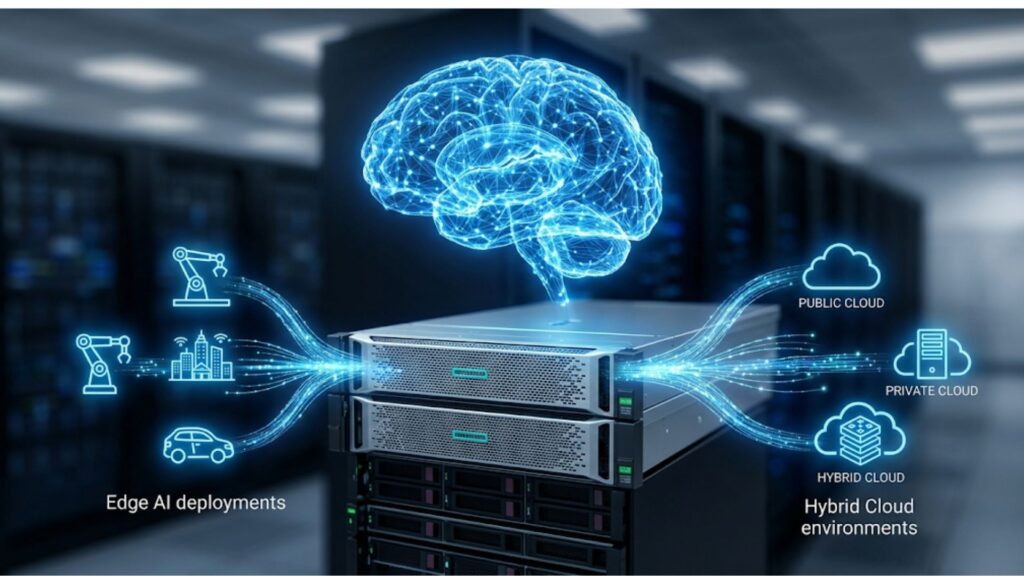
AI Inference and Edge Deployment Use Cases
The DL360 Gen12 is optimized for AI inference workloads, particularly in edge environments where low latency is critical.
Hybrid Cloud and Data Center Modernization
It supports hybrid cloud strategies, enabling seamless integration with modern IT environments.
Organizations planning data center modernization often adopt systems like Gen12 for scalability and performance.
Preparing for Next-Generation Workloads
The server is designed to handle future workloads, including AI, analytics, and high-performance computing.
| Workload Type | Capability |
| AI Inference | GPU-supported acceleration |
| Edge AI | Low-latency processing |
| Analytics | High memory bandwidth |
| HPC | High core density |
Should You Upgrade to DL360 Gen12?
When Upgrade Makes Sense
Upgrade if:
- Current infrastructure is limiting performance or scalability
- AI workloads are increasing
- Higher memory and bandwidth are required
Cost vs Performance Consideration
Gen12 offers improved performance but may require higher initial investment.
Organizations must balance cost with long-term performance benefits.
Long-Term Infrastructure Planning
Upgrading to Gen12 supports future scalability and reduces the need for frequent hardware refresh cycles.
| Scenario | Upgrade Recommendation |
| Running Gen10/Gen11 | Consider an upgrade for performance gains |
| AI workload adoption | Strongly recommended |
| Limited budget | Evaluate ROI carefully |
| Scaling infrastructure | Recommended |
Advantages and Limitations
Key Strengths (Performance, Cooling, AI Readiness)
- High core density
- Advanced cooling technologies
- AI-ready architecture
- Improved memory performance
Considerations (Cost, Complexity, Transition Planning)
- Higher cost compared to previous generations
- Complexity in deployment and configuration
- Transition planning required for upgrades
Planning a Future-Ready Server Upgrade?
Organizations evaluating next-generation infrastructure can benefit from tailored deployment strategies aligned with AI-ready and hybrid cloud requirements for the DL360 Gen12.
Catalyst Data Solutions Inc supports configuration, planning, and integration for AI-ready and hybrid cloud environments.
FAQs
What are the main improvements in DL360 Gen12 over Gen11?
Higher core counts, DDR5 memory, PCIe Gen5, and advanced cooling technologies.
Is DL360 Gen12 suitable for AI workloads?
Yes, it supports GPU acceleration and high-performance computing.
What cooling options are available?
Air cooling, closed-loop liquid cooling, and direct liquid cooling.
How much memory does Gen12 support?
Up to 8 TB of DDR5 memory.
Does it support GPU acceleration?
Yes, including support for GPUs like NVIDIA L4.
When should businesses upgrade to Gen12?
When performance, scalability, or AI workload requirements exceed current infrastructure capabilities.
How does Gen12 compare to previous DL360 models?
It offers significant improvements in performance, memory, and efficiency.