


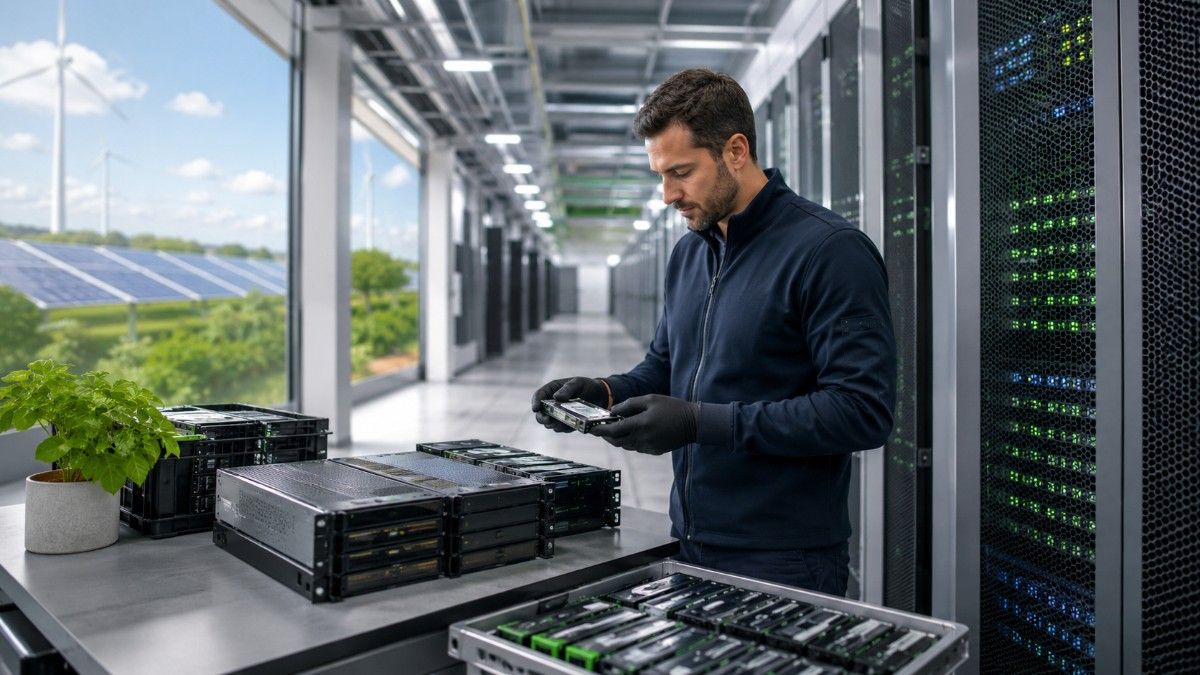
Data centers run the systems that support cloud platforms, AI workloads, storage, networking, and enterprise applications. But as demand grows, data centers face a difficult challenge: they must expand capacity while reducing waste, energy use, and hardware costs.
Data center e-waste reduction is not only an environmental goal. It is also a smarter lifecycle strategy. By extending hardware life, using refurbished IT equipment, improving energy efficiency, and managing old hardware through secure ITAD, data centers can lower cost, reduce risk, and support sustainability goals.
How Can Data Centers Reduce E-Waste and Carbon Footprint?
Data centers reduce e-waste and carbon footprint by managing IT hardware and energy use across the full lifecycle. This includes buying smarter, using equipment longer, redeploying assets, sourcing refurbished hardware, recycling responsibly, and improving power and cooling efficiency.
A strong circular IT model helps data center teams decide what to keep, reuse, resell, refurbish, or recycle. This gives operators more control over both hardware waste and carbon impact.
Key strategies include:
- Extending server, storage, and networking lifecycles
- Using refurbished or previous-generation hardware where it fits
- Redeploying equipment to lower-demand workloads
- Recycling non-usable assets through certified channels
- Using ITAD for secure data destruction and asset tracking
- Improving cooling systems
- Increasing use of renewable energy
- Measuring sustainability with clear KPIs
The best results come when sustainability is planned early. If teams only think about disposal after a refresh, they often lose resale value and create more waste.
Why Is E-Waste a Problem for Data Centers?
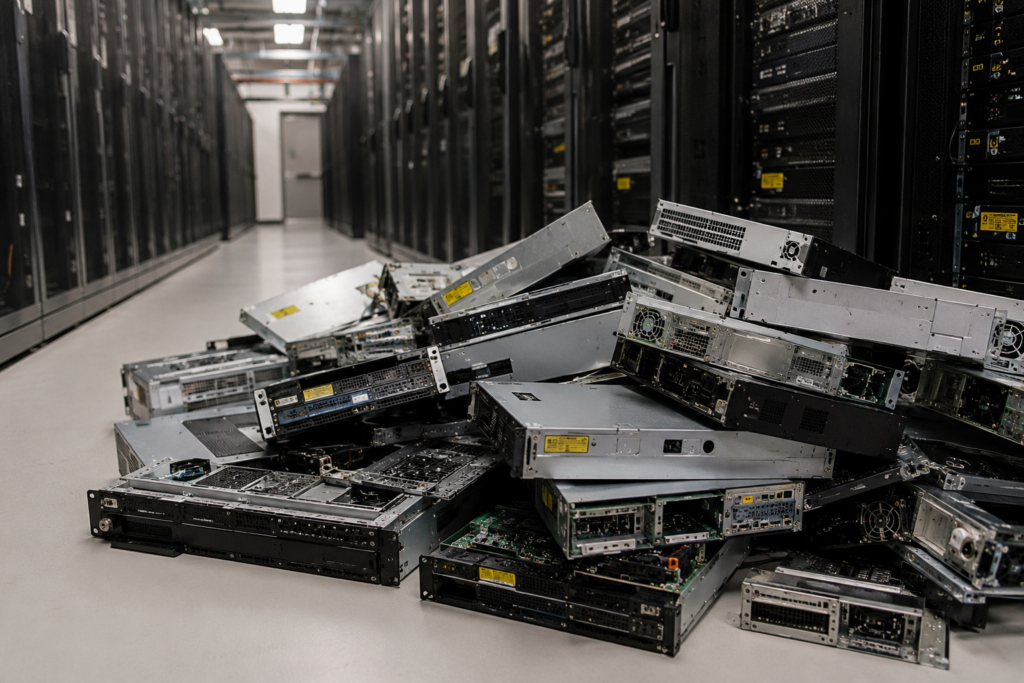
E-waste is a problem for data centers because servers, storage systems, networking gear, drives, power supplies, and GPUs are replaced often. These assets may contain valuable materials, sensitive data, and components that need safe handling.
In 2022, the world generated 62 million tonnes of e-waste, and only 22.3% was formally collected and recycled in an environmentally sound way. Global e-waste is expected to reach 82 million tonnes by 2030, which shows why data centers need better reuse, refurbishment, and recycling strategies.
Data centers also face refresh pressure. Hardware may be replaced due to performance needs, warranty limits, AI growth, or capacity planning. Without a clear process, usable equipment can sit in storage, lose market value, or enter poor disposal channels.
| Data Center E-Waste Challenge | Why It Matters | Better Lifecycle Response |
| Frequent refresh cycles | Creates large volumes of retired hardware | Plan reuse and resale before refresh |
| Sensitive data on drives | Increases security and compliance risk | Use certified data wiping or destruction |
| Valuable components | Missed recovery value if scrapped too early | Resell, refurbish, or harvest parts |
| Mixed hardware types | Makes disposal harder to manage | Track assets by type and condition |
| Poor recycling paths | Raises environmental and legal risk | Use verified ITAD and recycling partners |
Data center e-waste reduction works best when IT, procurement, security, finance, and sustainability teams work together. Each team affects how hardware is purchased, used, retired, and reported.
How Can Data Centers Extend Hardware Life?
Data centers can extend hardware life by maintaining equipment, matching it to the right workload, and redeploying assets before disposal. Not every system needs to run the most demanding workload until the day it is retired.
A server that no longer fits a high-performance application may still support backups, testing, staging, internal tools, or lower-priority workloads. This is where a lifecycle mindset creates value.
Audit the Hardware Estate
The first step is knowing what the data center owns. Many organizations lose value because they do not have a clear view of hardware age, condition, location, warranty status, and workload role.
A good asset audit should track:
- Serial number and model
- CPU, memory, storage, and GPU configuration
- Warranty and support status
- Current workload
- Power use
- Data-bearing components
- Reuse or resale potential
This inventory helps teams decide which assets should stay in service, move to another role, enter resale, or go through ITAD.
Match Assets to Workload Value
Extending hardware life does not mean keeping old systems in critical production roles. It means placing hardware where it still delivers safe and reliable value.
For example:
- Newer servers can support high-priority production workloads.
- Previous-generation servers can support backup or testing.
- Older switches can support lab or branch environments.
- Storage systems can support archive or non-critical workloads.
- GPUs can support lower-demand AI testing or rendering.
This type of planning helps organizations get more value from old data center hardware before choosing resale or recycling.
Upgrade and Repair Before Replacing
Small upgrades can extend useful life. Memory, drives, network cards, power supplies, and firmware updates may keep systems productive for longer.
Before replacing equipment, teams should ask:
- Can this asset be upgraded?
- Can it move to a lower-demand workload?
- Is repair more cost-effective than replacement?
- Does it still have resale value?
- Does it need secure data removal before reuse?
These questions reduce early disposal and help teams make better budget decisions.
How Does Refurbished IT Equipment Reduce Waste?
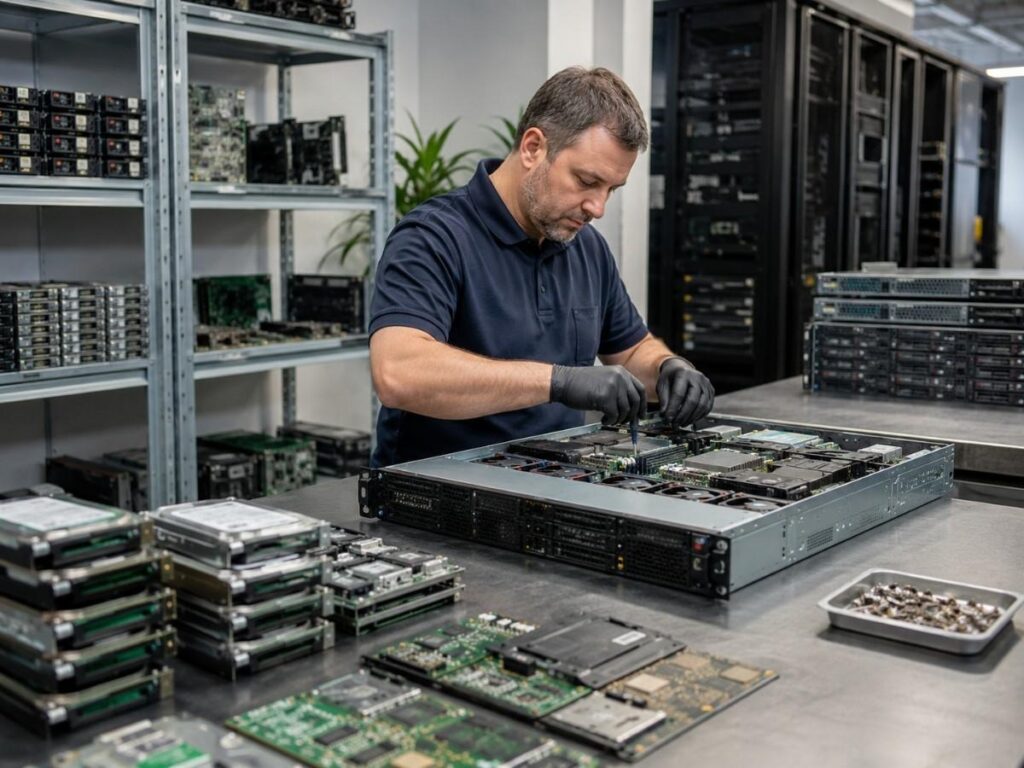
Refurbished IT equipment reduces waste by keeping usable hardware in servicCommon uses include:
- Backup infrastructure
- Development and testing
- Disaster recovery
- Expansion capacity
- Legacy application support
- Short-term projects
- Lab environments
Refurbished hardware should still be evaluated carefully. Data center buyers should look for testing, grading, configuration checks, warranty options, and clear sourcing standards.
| Use Case | Refurbished Equipment Fit | Waste Reduction Benefit |
| Backup systems | Strong fit for stable workloads | Extends hardware life |
| Test and dev | Strong fit for non-production use | Avoids new purchases |
| Expansion capacity | Good fit when timelines are tight | Reduces disposal demand |
| Legacy support | Useful for older platforms | Keeps compatible systems running |
| AI testing | Fit depends on GPU and workload | Reuses high-value components |
When supply chains are tight, refurbished supply options can also help data centers move faster without forcing every workload onto new equipment.
How Do Data Centers Recycle or Dispose of Old Hardware?
Data centers recycle or dispose of old hardware through a controlled ITAD process. ITAD stands for IT Asset Disposition. It helps organizations securely retire equipment while protecting data, recovering value, and reducing environmental risk.
A proper process includes asset tracking, chain of custody, data destruction, resale review, refurbishment, recycling, and reporting. This is important because data center equipment often contains sensitive business or customer data.e instead of sending it straight to recycling or disposal. It supports the circular economy by extending the life of servers, switches, storage, and GPUs.
For data centers, refurbished hardware can be useful when performance needs do not require the newest generation. It can also help when new equipment is delayed, over budget, or hard to source.
Use ITAD and Recycling for True End-of-Life
Not every asset should be recycled right away. Data centers should first check whether equipment can be reused, resold, refurbished, or harvested for parts.
A practical order of action is:
- Redeploy internally if the asset still fits a workload.
- Resell or buy back equipment with market value.
- Refurbish systems that can return to service.
- Harvest parts when full-system reuse is not practical.
- Recycle only when the asset has no further use.
A structured secure ITAD process helps data centers document each step. This supports compliance, security, and ESG reporting.
ITAD is also important for storage devices. Drives should be wiped, sanitized, shredded, or destroyed based on data sensitivity and company policy.
How Can Data Centers Reduce Energy Consumption?
Data centers reduce energy consumption by improving server utilization, removing idle hardware, modernizing power systems, and choosing equipment based on workload needs. Energy use is one of the largest parts of a data center’s carbon footprint.
The International Energy Agency projects that global data center electricity consumption could more than double to around 945 TWh by 2030, reaching just under 3% of global electricity use. AI and digital service demand are major drivers of this growth.
Reducing energy consumption often starts with better visibility. Teams need to know which systems are active, underused, idle, or ready for consolidation.
Practical steps include:
- Consolidate workloads onto fewer systems when possible.
- Remove or repurpose idle servers.
- Use power management settings.
- Upgrade power supplies where efficiency gains are clear.
- Match hardware size to workload needs.
- Monitor utilization and energy use.
- Retire inefficient systems through ITAD.
- Use refurbished hardware where it avoids unnecessary new production.
Energy savings and e-waste reduction often work together. When data centers reduce unused hardware, they lower power demand and avoid unnecessary equipment growth.
How Do Cooling and Renewable Energy Lower Carbon Footprint?
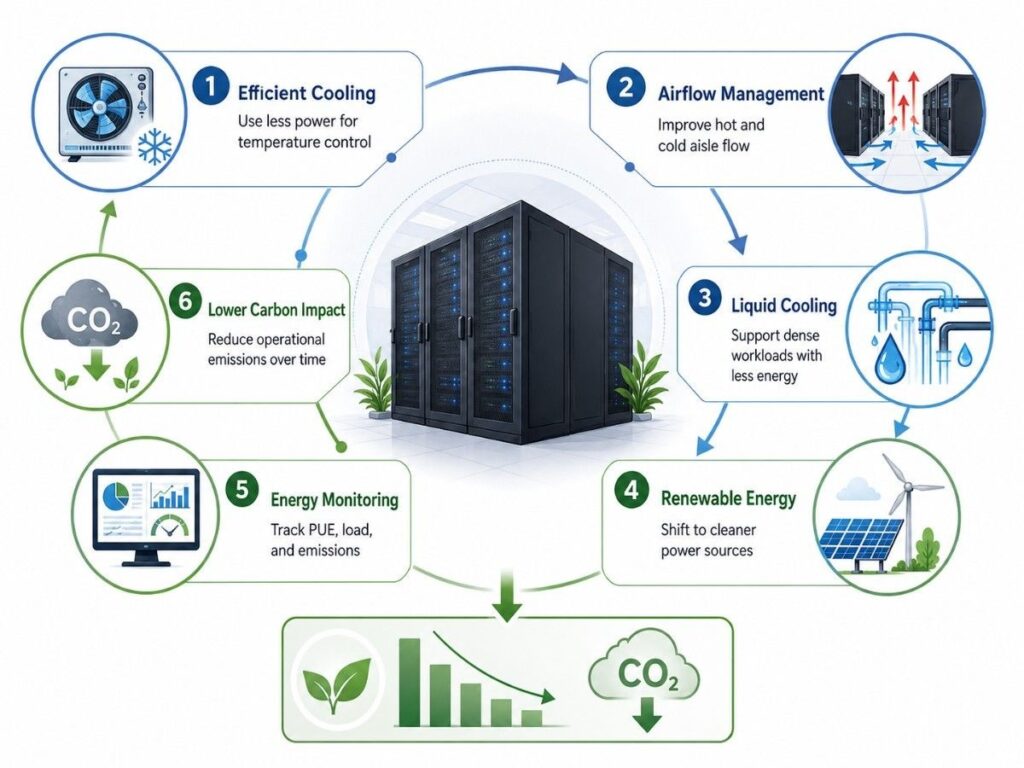
Cooling and renewable energy lower carbon footprint by reducing the energy required to operate the data center and by improving the source of that energy. Since servers generate heat, cooling strategy has a direct impact on power use.
Cooling improvements can include:
- Hot aisle and cold aisle containment
- Higher operating temperature ranges where safe
- Airflow management
- Blank panels in racks
- Efficient fans and cooling units
- Liquid cooling for dense workloads
- Free cooling where climate allows
Renewable energy can also reduce emissions tied to data center operations. Companies may use solar, wind, power purchase agreements, renewable energy credits, or on-site generation depending on location and energy strategy.
| Carbon Reduction Area | Practical Action | Sustainability Impact |
| Cooling efficiency | Improve airflow and containment | Reduces wasted cooling energy |
| Server utilization | Consolidate underused systems | Lowers total power draw |
| Renewable energy | Shift to cleaner power sources | Reduces energy-related emissions |
| Hardware lifecycle | Reuse and refurbish equipment | Lowers waste and embodied carbon |
| Measurement | Track energy and asset metrics | Improves reporting and planning |
Cooling should not be treated as a facilities-only issue. IT hardware choices affect heat, rack density, airflow, and power demand. Procurement, infrastructure, and facilities teams should plan together.
A broader sustainable IT approach helps connect hardware lifecycle decisions with energy and carbon reduction goals.
How Can Data Centers Measure Sustainability Success?
Data centers measure sustainability success by tracking both operational impact and hardware lifecycle impact. Energy use alone is not enough. Teams also need to track reuse, resale, recycling, and avoided waste.
Useful metrics include:
- Total electricity use
- Power Usage Effectiveness, or PUE
- Server utilization rates
- Idle hardware count
- Hardware reuse rate
- Refurbished hardware purchases
- ITAD recovery value
- Recycled equipment volume
- E-waste diverted from landfill
- Carbon emissions by scope
- Renewable energy percentage
Procurement teams should also track financial outcomes. A plan for IT cost reduction can connect sustainability work with budget value.
This matters because sustainability programs often gain more support when they show clear business results. Data center leaders should report both environmental and financial outcomes.
For example, a refresh project may show:
- Number of servers redeployed
- Value recovered through resale
- Drives securely destroyed
- Equipment recycled
- New purchases avoided
- Energy savings from consolidation
These metrics help companies make better decisions during future refresh cycles.
How Can Procurement Support Data Center E-Waste Reduction?
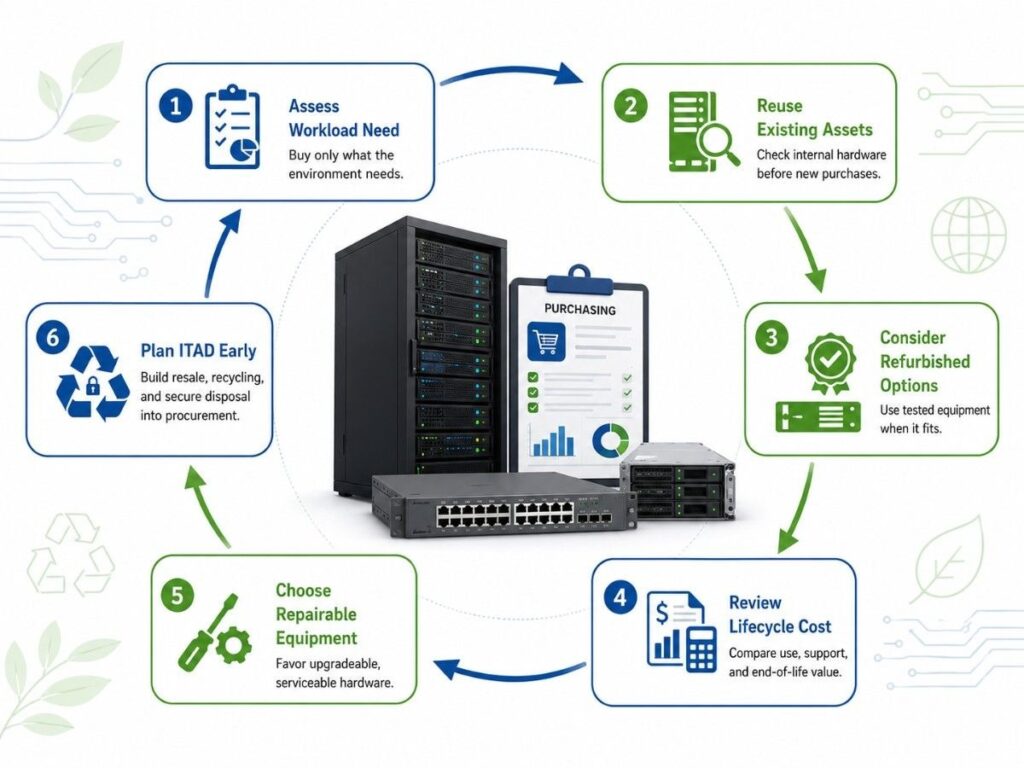
Procurement plays a major role in data center e-waste reduction. Buying decisions shape future waste, cost, energy use, and lifecycle value.
A better procurement process should ask:
- Does this workload need new hardware?
- Can refurbished hardware meet the requirement?
- Can existing assets be redeployed first?
- Will this equipment hold resale value?
- Are parts and support available?
- What is the expected energy profile?
- What is the end-of-life plan?
Procurement should not only compare purchase price. Teams should review total cost of ownership, lead time, lifecycle value, support needs, and disposal risk.
This is where tested refurbished equipment can support a more flexible strategy. It gives data centers more ways to balance performance, budget, availability, and waste reduction.
Need Support Building a Lower-Waste Data Center Strategy?
Catalyst Data Solutions helps organizations make practical infrastructure decisions across new, refurbished, and hard-to-find hardware markets. As a vendor-agnostic partner, Catalyst works with leading OEMs such as Cisco, Arista, HPE, and NVIDIA while focusing on what fits each customer’s performance, budget, timeline, and availability needs.
Catalyst supports data center teams with procurement, refresh planning, hardware reuse, refurbished sourcing, and ITAD decisions. This helps organizations reduce e-waste, recover value, control costs, and keep infrastructure projects moving during supply constraints.
FAQs
Q: What is the biggest source of e-waste in data centers?
The biggest source is retired IT hardware, including servers, storage systems, networking equipment, drives, power supplies, and GPUs. E-waste often increases during refresh cycles when old equipment is removed without a reuse, resale, or ITAD plan.
Q: How often should data centers refresh hardware to reduce waste?
Most data centers review hardware on a 3–5 year cycle, but replacement should depend on workload needs, support status, energy use, and resale value. Extending hardware life where practical can reduce waste and lower replacement costs.
Q: Can old data center hardware still have resale value?
Yes, old data center hardware can still have resale value if it is in good condition and in demand. Servers, networking gear, storage, and GPUs often retain value when they are processed before they become outdated.
Q: How does poor asset tracking increase data center e-waste?
Poor asset tracking causes companies to lose visibility into unused, aging, or retired equipment. This can lead to overbuying, long-term storage, missed resale value, and delayed recycling.
Q: What should data centers do before recycling old equipment?
Data centers should first check whether the equipment can be reused, resold, refurbished, or harvested for parts. Recycling should usually come after secure data removal and after higher-value reuse options are reviewed.