


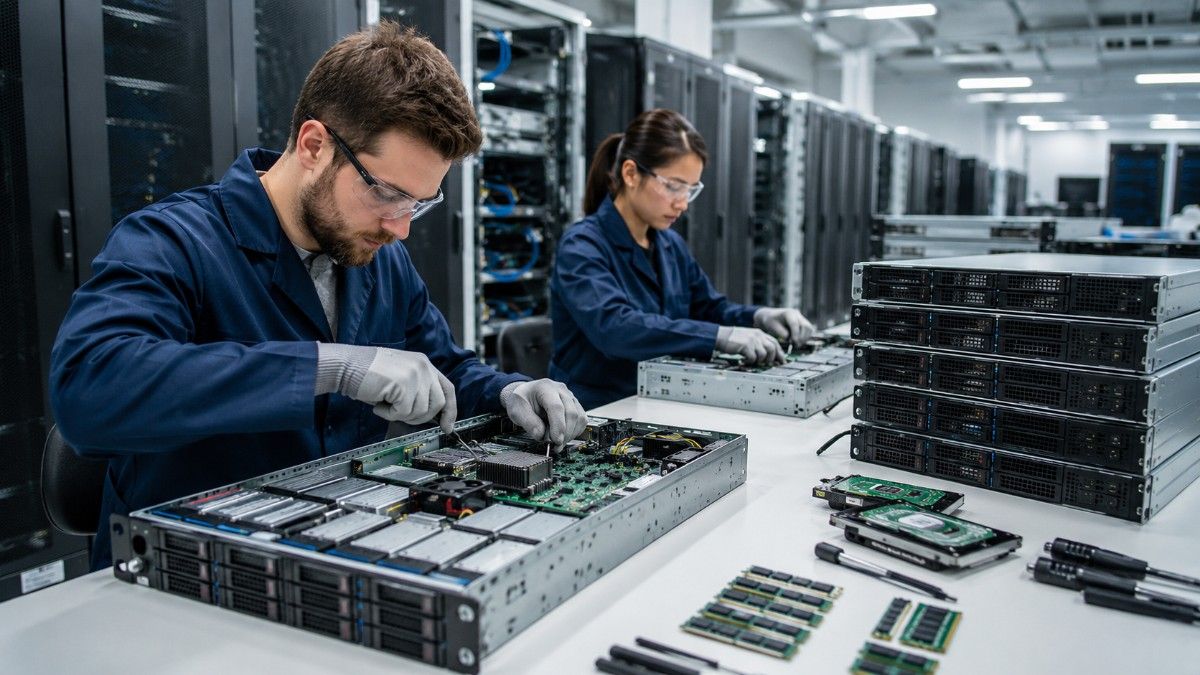
Enterprise IT buyers face a hard problem. New hardware costs more, lead times can slow down projects, and some parts become difficult to find right when teams need them most. At the same time, buying used equipment without a clear sourcing process can create risk. Refurbished hardware sourcing helps solve this gap by giving teams access to tested, reliable equipment without depending only on new inventory.
The challenge is knowing where that hardware comes from and whether it is safe to use in a business environment. Servers, switches, storage systems, and GPUs often leave data centers with years of useful life still left. When the sourcing process includes proper recovery, testing, data handling, and quality checks, refurbished hardware becomes a practical option for cost control, faster deployment, and lifecycle planning. This guide explains how refurbished hardware is sourced and what enterprise buyers should look for before they purchase.
Where Does Refurbished Hardware Come From?
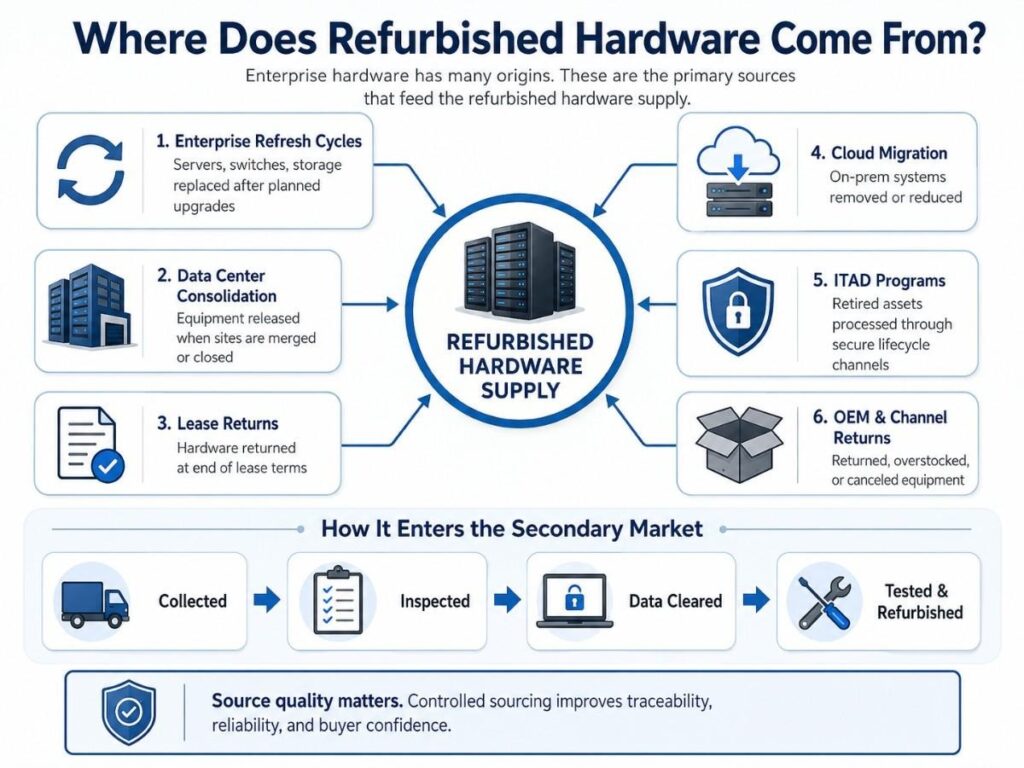
Refurbished hardware comes from enterprise environments where equipment has been replaced, returned, upgraded, or removed from service. In most cases, the hardware is not useless. It simply no longer fits the original owner’s current needs.
The global scale of retired electronics is also increasing. A record 62 million tonnes of e-waste was generated globally in 2022. This creates a large supply pool of electronics and IT equipment that may be recovered, tested, reused, refurbished, or recycled through proper channels.
The source of refurbished hardware matters because it affects quality, price, availability, risk, and buyer confidence. Hardware from a controlled data center refresh is very different from equipment with no clear history.
A clear asset recovery path helps organizations decide which retired equipment should be resold, redeployed, refurbished, or recycled.
| Primary Source | Why Hardware Becomes Available | Common Equipment | Buyer Benefit |
| Enterprise refresh cycles | Hardware is replaced after a planned lifecycle | Servers, switches, storage | Good quality and known business use |
| Data center consolidation | Sites are closed, moved, or merged | Racks, servers, networking | Large-batch availability |
| Lease returns | Equipment reaches the end of lease terms | Servers, laptops, storage | Predictable supply flow |
| Cloud migration | On-prem systems are reduced or removed | Compute, storage, network gear | Useful for hybrid and legacy needs |
| ITAD programs | Assets are retired through formal processes | Mixed enterprise hardware | Better tracking and compliance |
| OEM or channel returns | Equipment is returned, overstocked, or canceled | Newer or lightly used systems | Possible access to newer inventory |
The best source depends on the buyer’s need. A company that needs 100 matching servers may prefer a clean data center refresh batch. A company that needs a replacement switch may care more about speed, condition, and compatibility.
Why Do Enterprises Sell or Release Used Hardware?
Enterprises sell or release used hardware because their infrastructure needs change. Equipment may still work, but it may no longer match performance targets, warranty plans, security standards, or internal lifecycle rules.
Many companies refresh hardware every few years to improve performance, reduce power use, standardize platforms, or meet new workload needs. This creates a steady flow of servers, switches, storage, GPUs, and other equipment into the secondary market.
Enterprises also release hardware when they are:
- Moving workloads to the cloud
- Consolidating data centers
- Closing offices
- Upgrading network platforms
- Replacing storage systems
- Expanding AI or GPU infrastructure
- Ending lease agreements
- Standardizing around newer models
Cost recovery is another major reason. Retired IT equipment can still have resale value, especially if it is enterprise-grade and within a useful lifecycle window. Instead of storing old equipment or paying for disposal, companies can recover value through resale or buyback programs.
There is also a risk reason. Unused equipment often sits in storage rooms, cages, or warehouses. If it contains drives or asset tags, it can create security, compliance, and tracking concerns. A formal sourcing and ITAD process helps remove that risk.
For buyers, this release cycle creates opportunity. Refurbished hardware sourcing can provide access to systems that are difficult to buy new, delayed by supply chain limits, or too costly for secondary workloads.
How Does Refurbished Hardware Enter the Secondary Market?
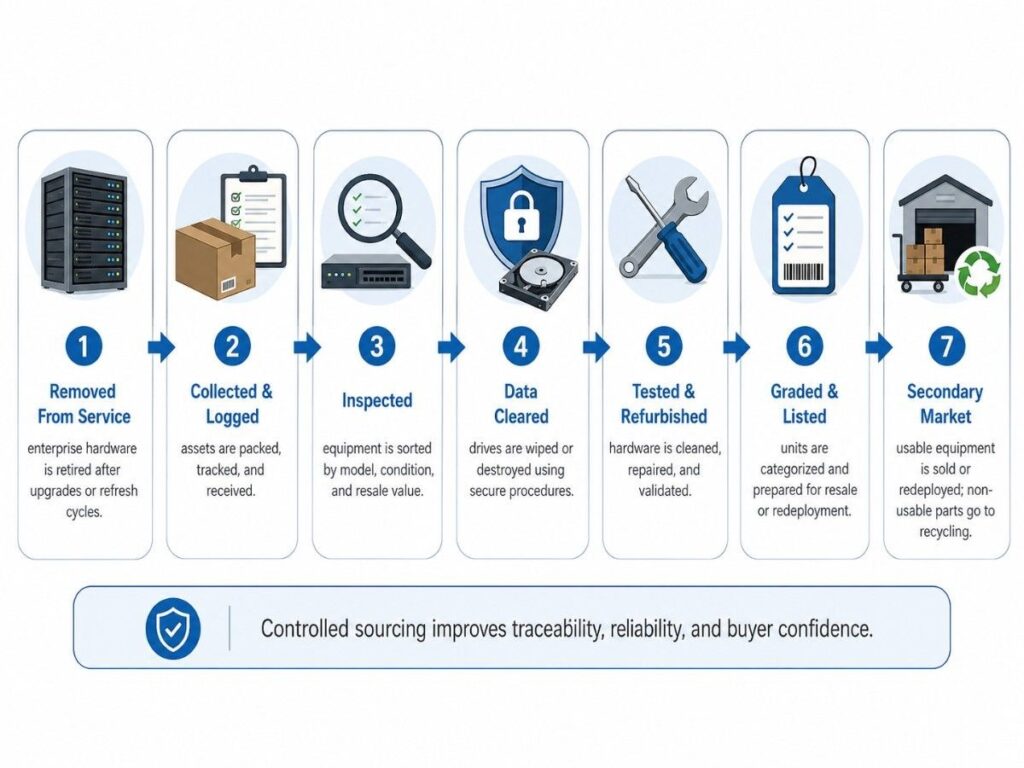
Refurbished hardware enters the secondary market through a series of steps. These steps usually begin when an organization removes equipment from active use and sends it through an ITAD, buyback, lease return, distributor, or remarketing channel.
The process often looks like this:
- Equipment is removed from service.
- Assets are counted, tagged, and packed.
- Hardware is shipped to a processing or refurbishment facility.
- Equipment is sorted by type, model, condition, and resale value.
- Data-bearing devices are wiped, sanitized, or destroyed.
- Hardware is tested, cleaned, repaired, and graded.
- Usable equipment is listed, sold, or held for future demand.
- Non-usable equipment is recycled through proper channels.
The quality of this process affects the final product. A server that has been tested, cleaned, configured, and documented is much more useful than one that has only been powered on.
A careful hardware sourcing strategy helps buyers compare new, refurbished, and hard-to-find options without forcing one sourcing path.
| Secondary Market Channel | How It Works | Strength | Risk to Check |
| ITAD providers | Retired assets are collected and processed | Strong tracking and compliance | Confirm data handling standards |
| Buyback programs | Companies sell retired hardware for value recovery | Good enterprise-grade supply | Condition may vary by batch |
| OEM/channel returns | Returned or excess hardware enters resale | Often newer inventory | Check support and warranty terms |
| Leasing companies | End-of-lease hardware is remarketed | Predictable supply batches | Specs and wear may vary |
| Secondary distributors | Supply is gathered from many sources | Broad availability | Source quality must be vetted |
| Data center liquidations | Large environments release equipment at once | High-volume sourcing | Configuration match may be limited |
The best refurbished hardware suppliers do more than locate inventory. They qualify it. They check the source, confirm condition, review configuration, and help buyers understand whether the hardware fits the intended environment.
What Are the Primary Sources of Refurbished Hardware?
The primary sources of refurbished hardware include ITAD programs, enterprise refreshes, data center projects, lease returns, OEM/channel returns, and buyback programs. Each source has a different mix of cost, risk, quality, and availability.
ITAD and buyback programs
ITAD and buyback programs are among the strongest sources of refurbished enterprise hardware. These programs collect retired equipment from companies that are upgrading, consolidating, or removing old assets from service.
A good ITAD process does more than remove equipment. It tracks assets, protects data, evaluates resale value, and separates usable hardware from equipment that should be recycled.
A typical ITAD or buyback process may include:
- Asset inventory
- Serial number tracking
- Chain of custody records
- Data wiping or drive destruction
- Hardware inspection
- Functional testing
- Value assessment
- Resale, redeployment, or recycling
For sellers, this supports value recovery and safer disposal. For buyers, it creates a more trusted supply of equipment that has passed through a formal process.
This channel is also important for circular IT strategy. When usable hardware moves from retirement into reuse, companies reduce waste and lower the need for new manufacturing.
What Types of Hardware Are Commonly Sourced Refurbished?
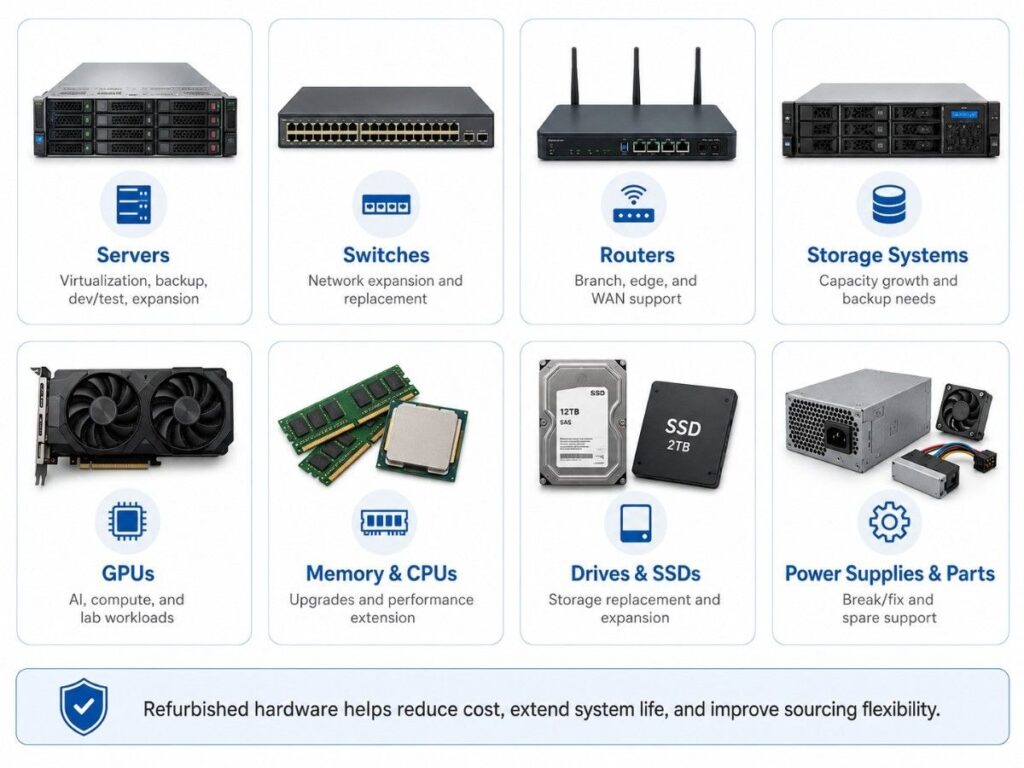
Common refurbished hardware includes servers, switches, routers, storage systems, GPUs, memory, CPUs, drives, power supplies, optics, and spare parts. These products are often sourced and refurbished because they are expensive, still useful after a refresh cycle, and needed for ongoing infrastructure support.
Servers are one of the largest categories. Buyers often source refurbished rack servers for virtualization, backup, development, test environments, private cloud, and secondary workloads.
Networking equipment is also common. Cisco, Arista, and other enterprise switches and routers can remain useful for years when they are tested and configured correctly. Refurbished networking gear can help companies expand capacity or replace failed units without waiting weeks for new equipment.
Storage and GPU hardware are also important. Storage systems, controllers, drives, and GPU cards can be valuable when the buyer needs compatible parts, lower cost, or faster availability.
A clear refurbished equipment process helps separate reliable enterprise hardware from equipment that should not be placed back into service.
| Hardware Type | Common Use Case | Why Buyers Source It Refurbished |
| Servers | Virtualization, backup, dev/test, expansion | Lower cost and faster access |
| Switches | Network expansion or replacement | Supports existing environments |
| Routers | WAN, branch, and edge use | Useful for legacy support |
| Storage systems | Backup and capacity expansion | Cost control for large data needs |
| GPUs | AI, lab, rendering, compute | High demand and limited supply |
| Memory and CPUs | Upgrades and repairs | Extends system life |
| Drives and SSDs | Storage expansion or replacement | Must be carefully tested |
| Power supplies and parts | Break/fix support | Keeps active systems running |
Not every refurbished product fits every workload. Critical production systems may need new hardware, full OEM support, or the latest platform. Refurbished hardware is often best for expansion, replacement, backup, testing, and mixed environments where cost and availability are major factors.
How Is Data Security Handled in the Sourcing Process?
Data security is one of the most important parts of refurbished hardware sourcing. Any equipment that held business data must be handled through a controlled process before it can be resold, reused, or recycled.
The main concern is data-bearing media. This includes hard drives, SSDs, NVMe drives, tapes, and some embedded storage inside appliances. These assets should be wiped, sanitized, or physically destroyed before hardware enters the resale channel.
A secure sourcing process should include:
- Chain of custody from pickup to processing
- Asset tags and serial number records
- Secure transport and receiving
- Data wiping based on accepted standards
- Physical destruction when wiping is not enough
- Certificates of data destruction
- Clear separation of reusable and non-reusable assets
Data security protects both the seller and the buyer. Sellers need proof that retired equipment did not create a data breach risk. Buyers need confidence that hardware has been cleared of prior data and prepared for a new environment.
Random sourcing creates more risk. Hardware from unknown channels may lack proof of origin, testing, or data handling. Enterprise buyers should work with suppliers that can explain where equipment came from, how it was processed, and what checks were completed.
What Are the Key Differences in Refurbished Hardware Sourcing Types?
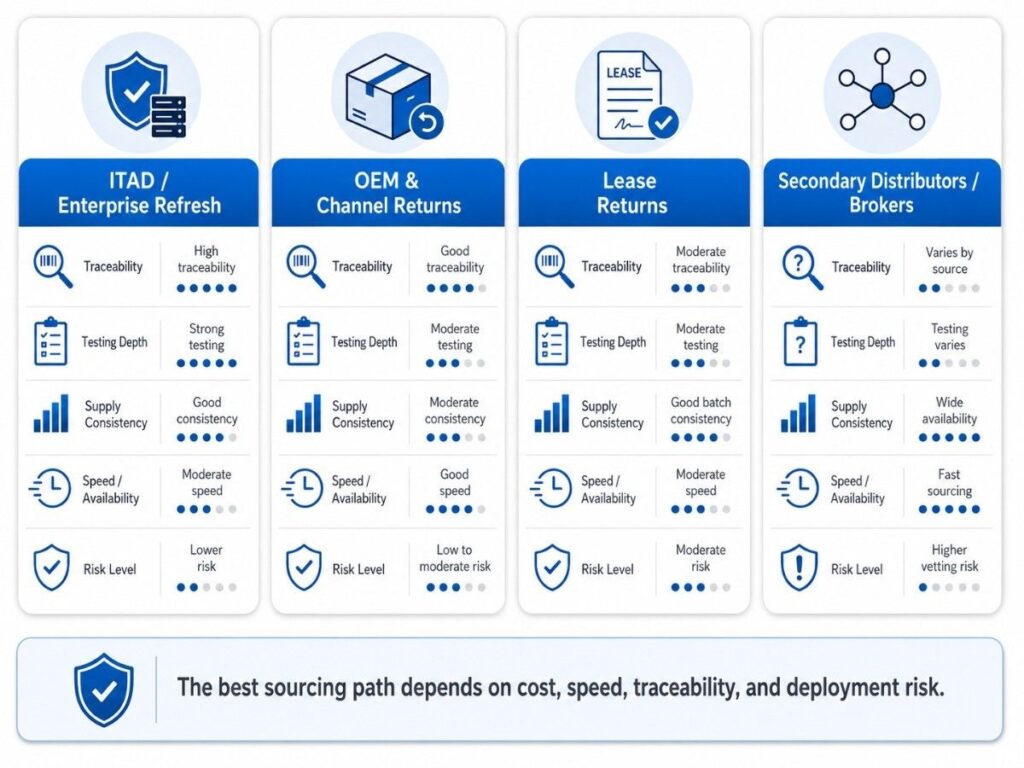
The key differences in refurbished hardware sourcing types come down to traceability, testing, consistency, cost, speed, and risk. A formal ITAD or OEM-channel source often provides better documentation. A broad secondary market source may offer more availability, but it needs stronger vetting.
For example, a batch of servers from one corporate data center refresh may have consistent specs and a known history. A mixed lot from several brokers may have lower pricing, but the buyer may need more time to confirm condition, firmware, and compatibility.
Sourcing type also affects deployment planning. A buyer that needs 200 matching servers should focus on supply consistency. A buyer that needs one replacement switch may care more about speed and compatibility.
Key differences include:
- Traceability: Can the supplier explain where the hardware came from?
- Testing depth: Was the equipment fully tested or only powered on?
- Configuration match: Does it match the required part numbers and specs?
- Warranty support: Is there coverage after purchase?
- Supply consistency: Can the same configuration be sourced again?
- Compliance: Was the hardware handled through a secure process?
- Lead time: Is the hardware ready to ship or still being processed?
Good refurbished hardware sourcing is not about finding the lowest price. It is about finding the right balance between cost, availability, quality, and risk.
A buyer may save money upfront by choosing the cheapest option. But if the hardware fails testing, lacks the right parts, or creates support issues, the total cost can rise quickly. A stronger sourcing process helps prevent those problems before deployment.
How Should Enterprises Evaluate a Refurbished Hardware Supplier?
Enterprises should evaluate a refurbished hardware supplier based on sourcing transparency, testing standards, inventory access, data security, compatibility knowledge, and warranty support.
A supplier should be able to explain where the hardware comes from and how it is processed. Vague answers are a warning sign. Buyers should also ask how equipment is tested, how failed components are handled, and what support is available after purchase.
Important questions include:
- Does the supplier work with enterprise-grade equipment?
- Can they support mixed OEM environments?
- Can they source both new and refurbished options?
- Do they understand compatibility and deployment needs?
- Can they provide hardware during shortages?
- Do they offer testing records or warranty coverage?
- Do they understand lifecycle and ITAD needs?
This is especially important in supply-constrained markets. A supplier with access to OEM channels, distribution networks, ITAD programs, and secondary inventory can often present more practical options than a product-only reseller.
For buyers trying to lower costs without hurting performance, a practical cost optimization plan can help identify where refurbished hardware makes sense and where new equipment is the better choice.
How Does Refurbished Hardware Sourcing Support Better IT Decisions?
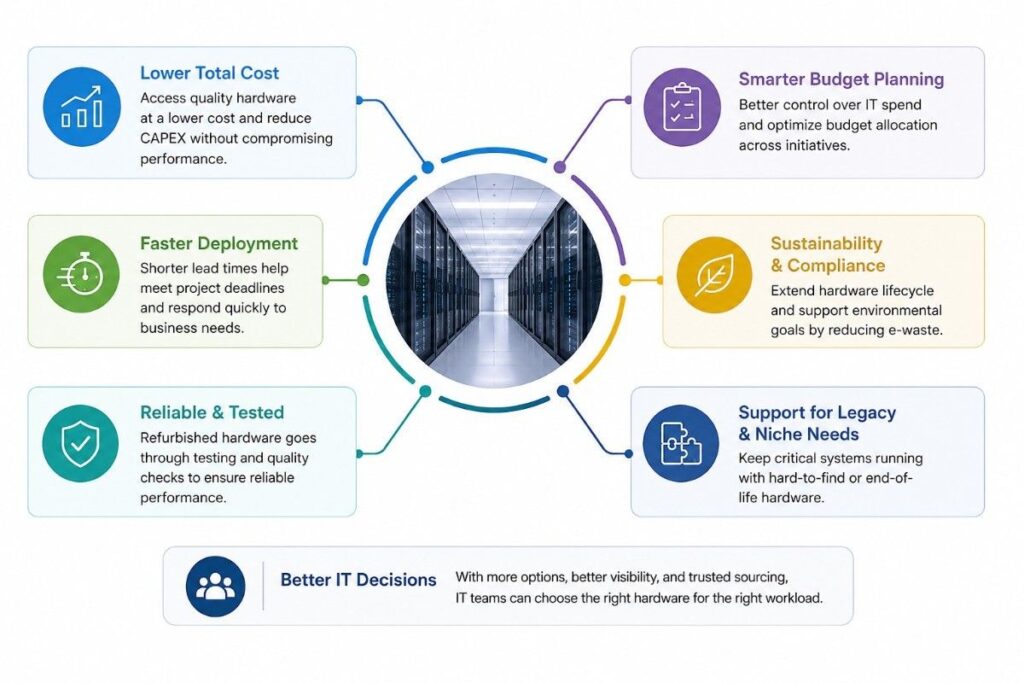
Refurbished hardware sourcing supports better IT decisions by giving buyers more options. When teams only consider new hardware, they may face higher prices, limited stock, or long lead times. When they include refurbished hardware, they can compare cost, timing, performance, and lifecycle fit.
This does not mean refurbished hardware is right for every workload. New equipment may be better for mission-critical systems, high-performance projects, or environments that need the latest OEM support. Refurbished hardware may be better for expansion, secondary workloads, backup, lab use, or compatible replacement needs.
The best strategy is workload-based. Buyers should match the sourcing decision to the business need, not just the product category.
A strong refurbished hardware sourcing plan can help organizations:
- Reduce capital expense
- Shorten deployment timelines
- Extend the life of existing systems
- Maintain legacy infrastructure
- Support sustainability goals
- Recover value from retired assets
- Build a more flexible lifecycle plan
When used correctly, refurbished hardware is not only a lower-cost option. It is a practical tool for infrastructure planning, procurement flexibility, and lifecycle management.
Need a Smarter Way to Source Refurbished Hardware?
Catalyst Data Solutions helps organizations source enterprise infrastructure across new, refurbished, and hard-to-find markets. As a vendor-agnostic partner, Catalyst works with leading OEM and technology partners including Cisco, Arista, HPE, NVIDIA to help buyers compare options based on performance, budget, availability, and lifecycle fit.
This approach gives IT and procurement teams more flexibility when standard supply channels cannot meet project needs. Whether the goal is faster deployment, cost control, legacy system support, or sourcing equipment during shortages, Catalyst helps organizations evaluate the right mix of new and refurbished hardware without forcing one vendor or one sourcing path.
Frequently Asked Questions
Q: What is refurbished hardware sourcing?
Refurbished hardware sourcing is the process of finding, checking, testing, and preparing used enterprise IT equipment for reuse. It often includes servers, switches, storage, GPUs, and spare parts. Companies use it to reduce costs, improve availability, and support existing infrastructure.
Q: Where does refurbished enterprise hardware come from?
Refurbished enterprise hardware often comes from data center refreshes, ITAD programs, lease returns, OEM or channel returns, and buyback programs. Many companies release equipment after normal refresh cycles, even when the hardware still has useful life.
Q: Is refurbished hardware reliable for enterprise use?
Yes, refurbished hardware can be reliable for enterprise use when it is properly sourced, tested, and supported. It is often used for backup systems, lab environments, secondary workloads, and infrastructure expansion. Reliability depends on sourcing quality, testing standards, and supplier expertise.
Q: How much can refurbished hardware reduce costs?
Refurbished hardware can often reduce upfront costs by 30–70%, depending on product type, generation, condition, and demand. This makes it useful when budget constraints, lead times, or availability issues affect normal procurement.
Q: What hardware is most commonly sourced refurbished?
Servers, switches, routers, storage systems, GPUs, memory, CPUs, drives, and power supplies are commonly sourced refurbished. These products are popular because they are costly when new and often remain useful after the first owner upgrades.
Q: How is data protected before used hardware is resold?
Data is protected through asset tracking, chain of custody, wiping, sanitization, or physical drive destruction. Data-bearing media should follow accepted data destruction practices before equipment enters resale or reuse channels.
Q: When should a company choose refurbished over new hardware?
A company should consider refurbished hardware when it needs faster availability, lower cost, legacy compatibility, or expansion capacity. New hardware may still be better for critical workloads that require the latest performance, warranty, or support terms.
Q: What should buyers check before purchasing refurbished hardware?
Buyers should check the source, testing process, configuration, warranty, compatibility, and supplier experience. They should also confirm that data-bearing components were handled securely and that the hardware fits the intended workload.