

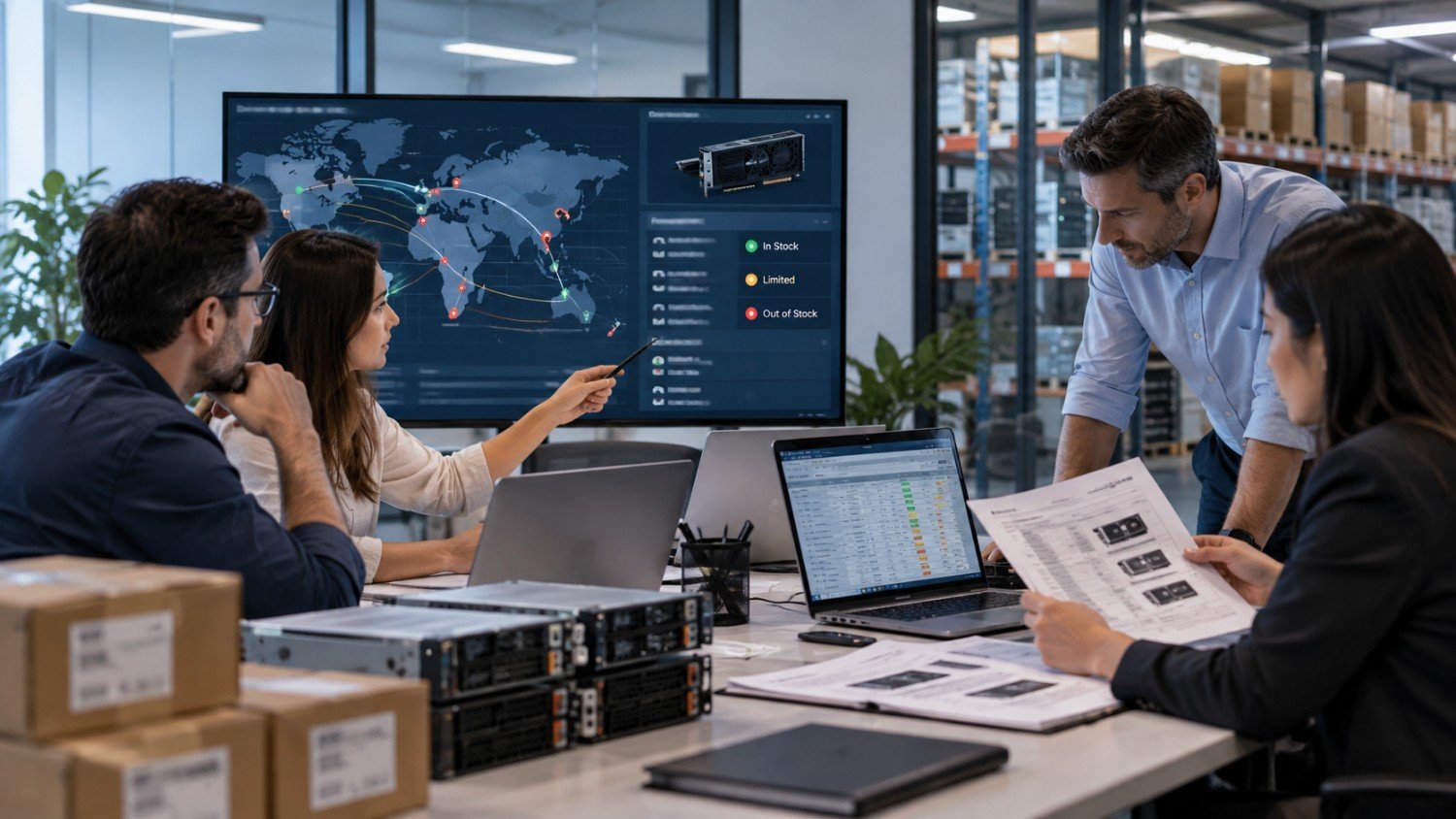
AI infrastructure procurement is no longer just about finding GPUs at the right price. A successful deployment depends on the full bill of materials (BOM), including memory, CPUs, SSDs, NICs, optics, power, cooling, cables, and other parts that must arrive and work together on schedule.
When even one critical component is delayed, allocated, or available only from a single source, an entire rack can sit unused. That is why a resilient AI infrastructure BOM should identify supply risks early, define approved alternatives, support multi-OEM sourcing, and include compatibility checks before any part is replaced.
This guide explains how to find single-SKU and single-source risks, manage scarce components, compare primary and secondary-market options, and balance cost, availability, performance, and support. The goal is not to buy whatever is available. It is to build a procurement plan that can adapt to supply changes without putting workload performance, compatibility, or the deployment date at risk.
Key Takeaways
- A resilient AI infrastructure BOM separates fixed technical requirements from preferred part numbers, so teams know where substitution is safe.
- GPUs matter, but DDR5/RDIMMs, SSDs, CPUs, NICs, optics, power, and cooling can also stop an AI deployment.
- Approved alternates should be qualified before supply becomes urgent.
- Primary and secondary sourcing can work together, but condition, provenance, firmware, warranty, compatibility, and support must be clear.
- The best procurement choice balances performance, availability, total project cost, and schedule risk, not unit price alone.
What Is a Resilient AI Infrastructure BOM?
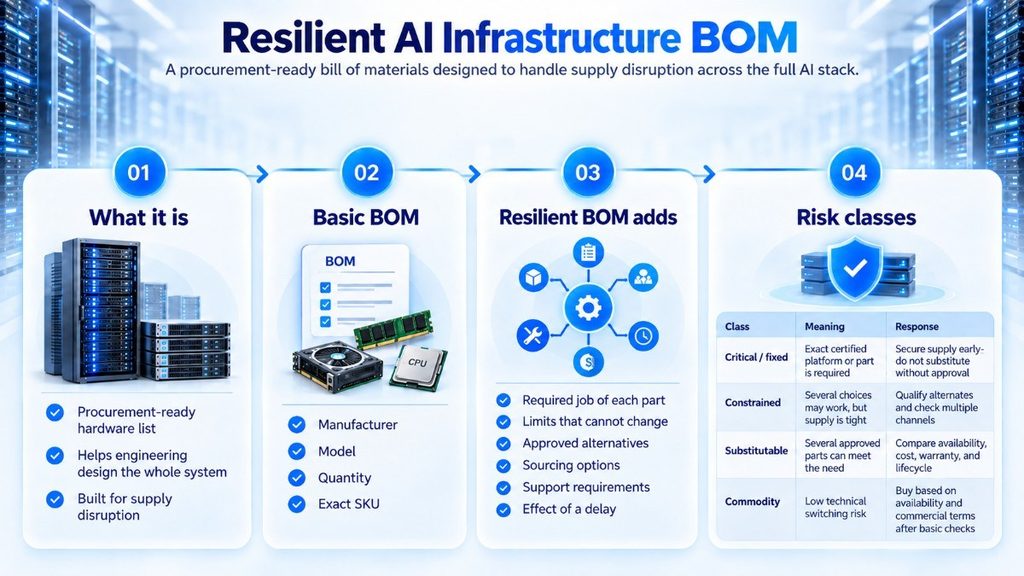
A resilient AI infrastructure BOM is a procurement-ready hardware list that can handle normal supply disruption without forcing the engineering team to redesign the whole system.
A basic BOM may list a manufacturer, model, quantity, and exact SKU. A resilient BOM goes further. It records the job each part must perform, the limits that cannot change, approved alternatives, sourcing options, support requirements, and the effect of a delay.
That wider view matters because an AI deployment depends on more than accelerators. A strong enterprise AI infrastructure strategy should account for compute, memory, networking, storage, power, cooling, and operations as connected parts of the same deployment.
| BOM risk class | What it means | Procurement response |
| Critical / fixed | Exact certified platform or part is required | Secure supply early; do not substitute without approval |
| Constrained | Several choices may work, but supply is tight | Qualify alternates and check multiple channels |
| Substitutable | Several approved parts can meet the need | Compare availability, cost, warranty, and lifecycle |
| Commodity | Low technical switching risk | Buy based on availability and commercial terms after basic checks |
The important shift is simple: the BOM becomes a risk map, not just a shopping list.
Which AI Infrastructure Components Are Most Supply-Constrained?
Supply risk changes by platform, quantity, region, and project date. A part that is easy to obtain for a four-node pilot may be difficult to secure for a 100-node deployment.
Supply pressure can affect several parts of an AI deployment, not just the GPU.
The components below deserve the closest procurement review because shortages, exact-SKU dependencies, or limited substitutes can delay the full system.
| Component | Current procurement concern | Why substitution can be difficult |
| GPUs / HBM | Generation, platform, allocation, quantity | Form factor, memory, interconnect, software and server support |
| DDR5 / RDIMMs | Tight server memory supply and pricing | Rank, capacity, speed, population and OEM qualification |
| Enterprise SSDs | Strong AI/data-center demand | Firmware, endurance, form factor and storage support |
| CPUs | Platform-specific supply and long lead times | Socket, BIOS, PCIe lanes, TDP and memory support |
| NICs / optics | Exact high-speed configurations | Fabric, connector, firmware, topology and cabling |
| Power / cooling | High-density project demand | Rack, PDU, PSU, CDU, manifold and facility dependencies |
GPUs and HBM
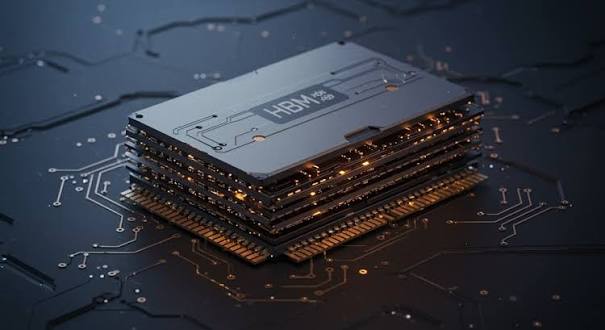
The accelerator may be the largest line item, but the procurement risk is usually more specific than “we need GPUs.”
Teams may need an exact GPU generation, memory capacity, form factor, interconnect, server platform, and quantity. HBM is integrated into modern accelerator packages, so buyers cannot treat GPU memory as an independent field-replaceable part.
GPU procurement should begin with the workload, not the accelerator model.
Teams should first assess factors such as model size, memory needs, training or inference demands, server compatibility, networking, storage, rack power, cooling, software support, and expected utilization.
A structured GPU infrastructure assessment helps frame those requirements before a specific GPU SKU is selected.
A newer accelerator may offer more performance, but it is not useful if the server, network, or facility cannot support it.
DDR5 and Server RDIMMs
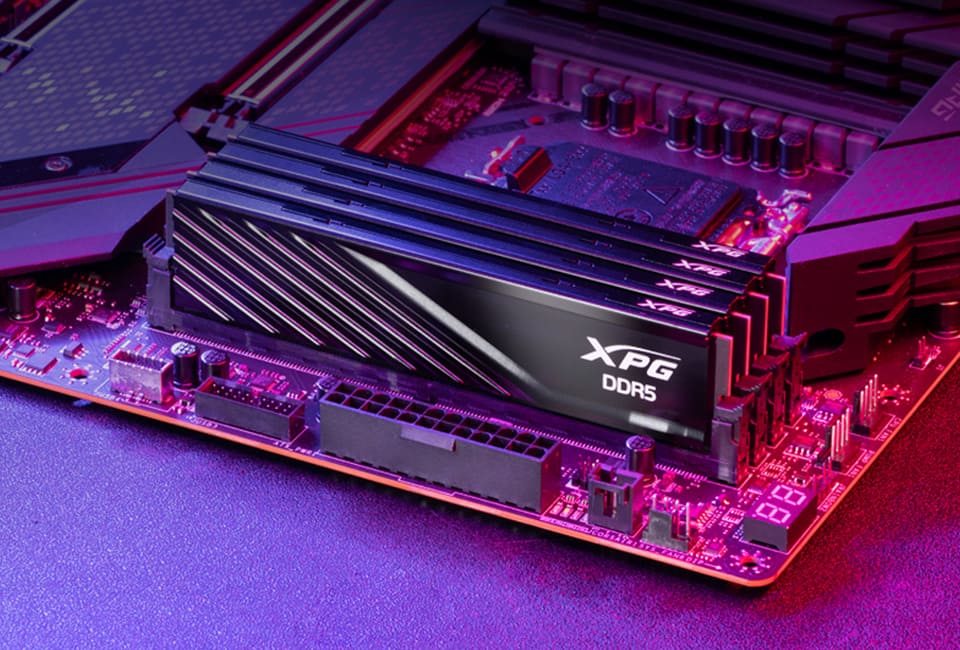
Server memory is one of the clearest supply risks in 2026.
TrendForce reported in July 2026 that the server DRAM market remained undersupplied and forecast 13–18% quarter-over-quarter server DRAM contract-price growth in Q3 2026. It also expected supply pressure to continue into 2027.
Its September 7 update said supplier inventories remained at historic lows as AI demand drove greater use of HBM3e and high-capacity RDIMMs.
For procurement teams, the problem is not only memory price. Capacity, rank, speed, DIMM population rules, platform generation, and OEM qualification can make the list of valid substitutes much smaller.
Memory planning now needs to be part of the broader AI sourcing process, especially as higher AI demand affects server memory availability and pricing. The DDR5 memory supply outlook explains how these pressures can influence infrastructure planning and procurement decisions.
Enterprise SSDs
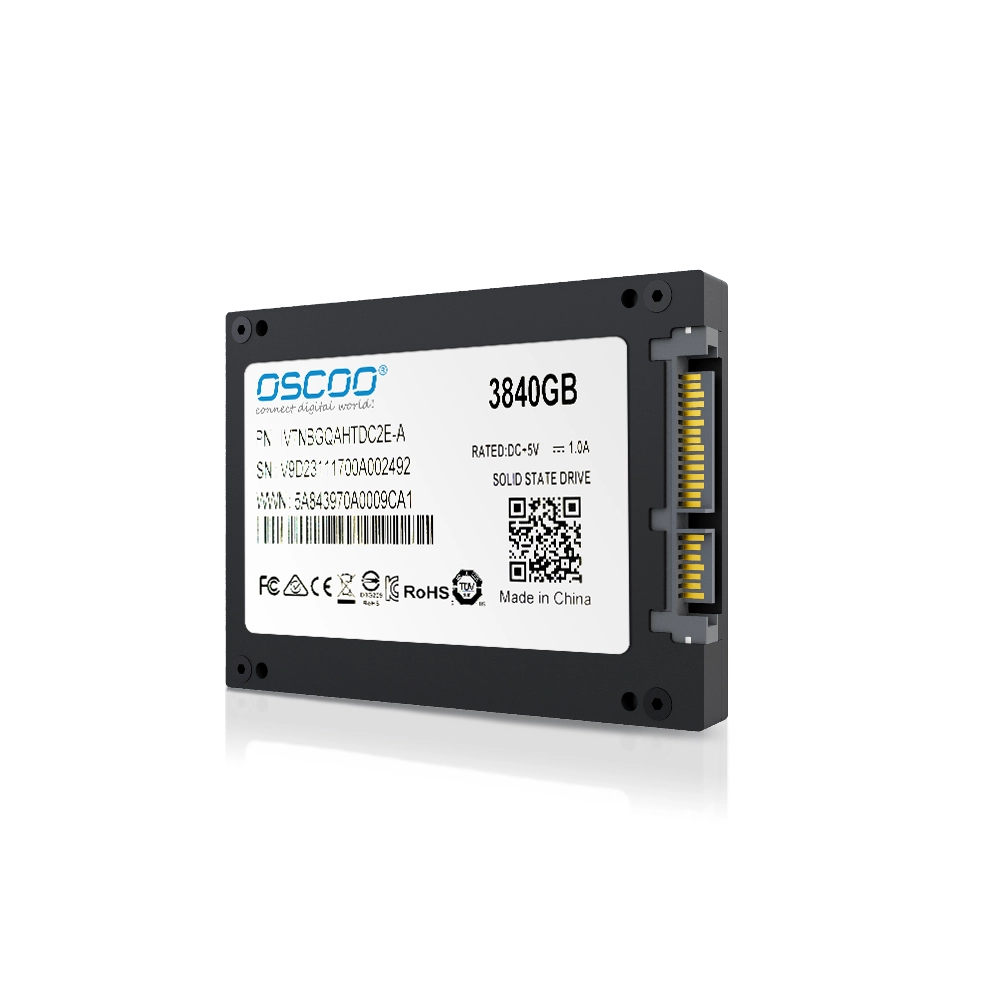
AI systems need more than storage capacity. Training, inference, checkpointing, vector databases, caching, and large active datasets can require high throughput and low latency.
Enterprise SSD supply has faced strong pressure in 2026. TrendForce reported in September that enterprise SSD demand remained elevated as generative AI services, data-center deployments, and large AI server shipments increased.
A storage substitution still requires care. Buyers should check:
- PCIe or NVMe generation
- U.2, U.3, E1.S, E3.S, or other form factor
- endurance rating
- firmware
- capacity
- controller or backplane support
- hot-swap behavior
- platform qualification
A drive that physically fits is not always a safe production substitute.
CPUs
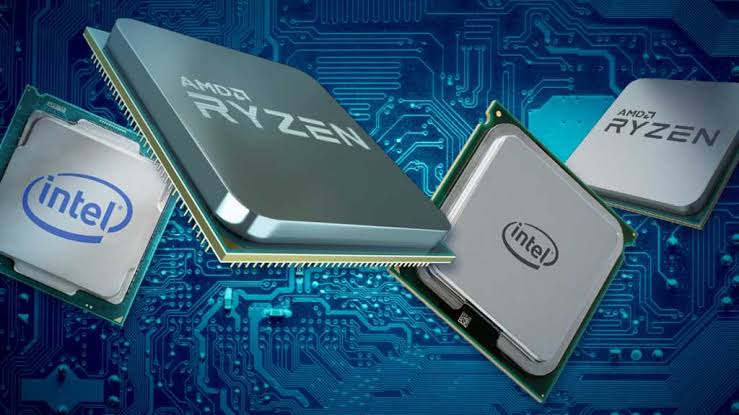
AI servers can also be delayed by host CPU availability.
TrendForce reported in April 2026 that constraints in CPUs and PCBs had pushed lead times for some general server components toward one year. It also noted longer lead times for power-management and BMC components.
CPU alternates must match more than core count. Socket, BIOS support, memory channels, PCIe lanes, thermal limits, licensing, and platform support can all matter.
NICs, Optics, Switches, and Cables
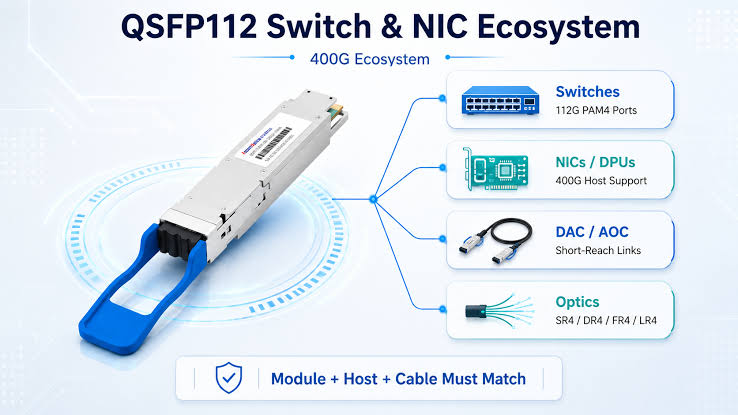
Networking becomes part of the compute system when workloads scale across several GPU nodes.
An exact NIC may be tied to PCIe generation, link speed, firmware, connector type, Ethernet or InfiniBand fabric, switch topology, and optics.
NVIDIA’s current HGX reference architecture gives specific network-bandwidth and SuperNIC guidance for multi-node H100, H200, and B200 systems. Its recommended designs can call for several 200 or 400 Gb/s interfaces per system.
That means “another 400 GbE NIC” is not automatically an equal replacement.
The same issue applies to transceivers, DACs, AOCs, breakout cables, and switch ports. One missing low-cost cable can prevent a rack from going live.
Power and Cooling Are Part of the BOM
Power and cooling should not be treated as problems to solve after compute has been ordered.
High-density servers may depend on exact PSUs, rack PDUs, liquid-cooling equipment, manifolds, CDUs, connectors, and rack configurations.
HPE’s current Cray XD670 documentation shows how tight those relationships can be. Its liquid-cooled H200 configurations require specific rack and manifold components, while supported CPUs, memory configurations, and cooling options are also defined at the platform level.
This is why a server can be “available” while the complete deployable configuration is not.
Teams should build the BOM around the whole rack, not only the server.
How to Find Single-Source and Single-SKU Risks
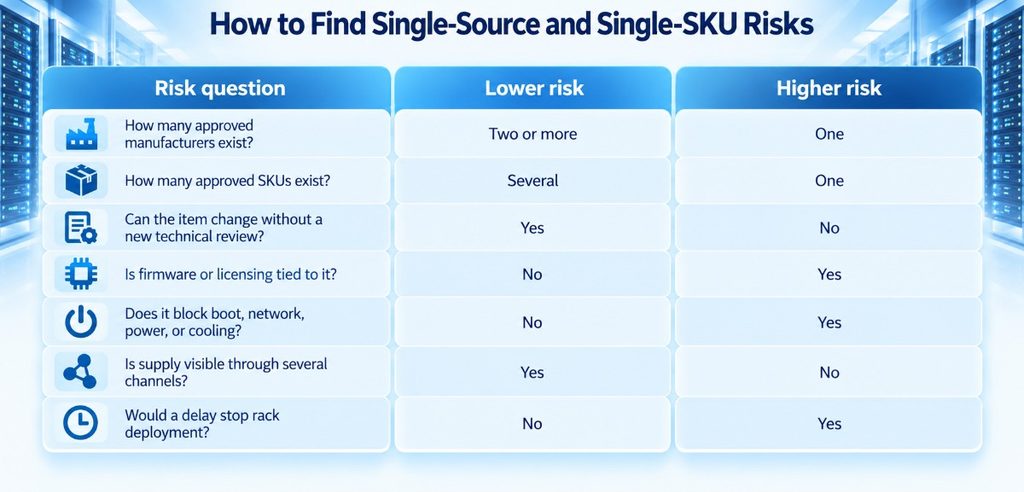
A single-source risk exists when only one supplier, OEM, or channel can provide the required item.
A single-SKU risk exists when the design depends on one exact part number even though other products may have similar specifications.
Neither condition is always wrong. Some certified systems require exact parts. The risk comes from failing to identify that dependency early.
| Risk question | Lower risk | Higher risk |
| How many approved manufacturers exist? | Two or more | One |
| How many approved SKUs exist? | Several | One |
| Can the item change without a new technical review? | Yes | No |
| Is firmware or licensing tied to it? | No | Yes |
| Does it block boot, network, power, or cooling? | No | Yes |
| Is supply visible through several channels? | Yes | No |
| Would a delay stop rack deployment? | No | Yes |
Start with parts that are both hard to replace and able to stop the schedule.
A $200 item that prevents a $500,000 system from going live deserves more attention than its price suggests.
Approve Alternates Before You Need Them
An approved alternate is not simply a part with similar specifications.
It is a substitute that the required engineering, operations, support, security, and procurement teams have accepted for the intended role.
For each constrained component, define:
- minimum technical requirements;
- acceptable manufacturers or product families;
- performance floor;
- physical and electrical limits;
- firmware and driver requirements;
- warranty and support terms;
- security requirements;
- who can approve a deviation.
The best time to do this is during design.
Catalyst’s multi-OEM shortlist process follows the same principle: start with the requirement, then identify more than one viable hardware path where the architecture allows it.
A separate vendor-neutral infrastructure design approach can also reduce unnecessary lock-in before the BOM reaches purchasing.
Compatibility Checks Before Substituting Components
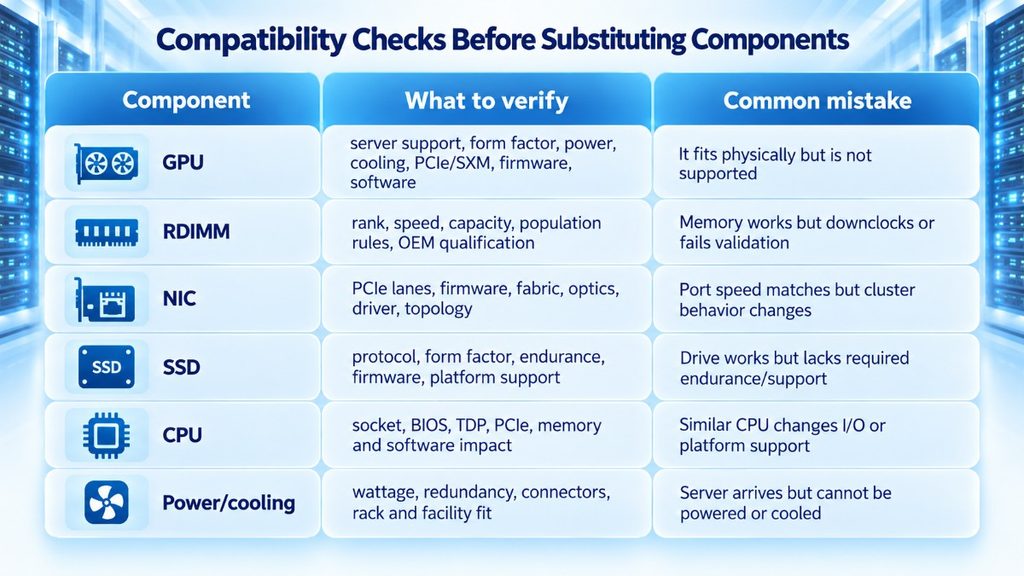
Resilient procurement fails when an available replacement creates a new technical problem.
Do not approve a substitute based only on capacity, speed, or connector type.
| Component | What to verify | Common mistake |
| GPU | server support, form factor, power, cooling, PCIe/SXM, firmware, software | It fits physically but is not supported |
| RDIMM | rank, speed, capacity, population rules, OEM qualification | Memory works but downclocks or fails validation |
| NIC | PCIe lanes, firmware, fabric, optics, driver, topology | Port speed matches but cluster behavior changes |
| SSD | protocol, form factor, endurance, firmware, platform support | Drive works but lacks required endurance/support |
| CPU | socket, BIOS, TDP, PCIe, memory and software impact | Similar CPU changes I/O or platform support |
| Power/cooling | wattage, redundancy, connectors, rack and facility fit | Server arrives but cannot be powered or cooled |
This NVIDIA GPU server build guide shows why the GPU, CPU, memory, storage, networking, and power path should be treated as one system.
The procurement rule should be clear: no substitution until the team knows what changed, what was tested, who approved it, and whether support ownership changed.
Lead Times, Allocation, and Minimum Orders
A quoted lead time is only one part of supply risk.
A supplier may also have:
- allocation limits;
- minimum order quantities;
- limited stock by region;
- partial-ship rules;
- factory configuration windows;
- non-cancelable orders;
- short quote-validity periods.
For every critical item, record four dates:
- Quote expiration date
- Latest safe order date
- Promised ship date
- Latest acceptable arrival date
Then record quantity available now, expected inbound supply, minimum order requirements, and whether partial shipments are allowed.
This prevents a common failure: engineering approves the BOM, finance takes several weeks to approve the order, and the inventory shown on the original quote is gone.
Primary vs. Secondary-Market Sourcing
Primary sourcing includes OEM-direct supply, authorized resellers, VARs, and distributor-backed inventory.
This path often makes sense for new platforms, large standard builds, current support contracts, and systems where OEM entitlement matters.
Secondary sourcing can help with previous-generation hardware, expansion of an installed base, replacement parts, spares, and hard-to-find exact SKUs.
Catalyst’s approach to OEM IT hardware sourcing treats those channels as different procurement tools rather than assuming one source fits every project.
For secondary equipment, verify:
- whether it is used, pre-owned, refurbished, recertified, or OEM-surplus;
- serial number and provenance;
- testing process;
- firmware and licensing status;
- warranty terms;
- exact platform compatibility;
- return and failure procedures;
- support responsibility.
These terms are not interchangeable.
High-end accelerator sourcing can also involve export controls, destination restrictions, and end-user or end-use screening. Procurement plans should not assume unrestricted international shipment.
How to Balance Cost, Availability, and Performance
The lowest unit price is not always the lowest project cost.
A cheaper component can cost more if it delays deployment, lowers throughput, adds support work, or forces another architecture review.
Use four factors.
| Factor | Main question | Reasonable trade-off |
| Performance | Does it meet the workload requirement? | Accept lower peak speed if the workload target is still met |
| Availability | Can the full quantity arrive on time? | Pay more when delay costs more than the price difference |
| Cost | What is the full cost, not just unit price? | Accept a higher unit price if total project cost falls |
| Lifecycle | Can it be supported, expanded, reused, or resold? | Favor better support or reuse value when it improves TCO |
Compare approved option A with approved option B under the same workload and schedule assumptions.
Do not compare one SKU’s price with another SKU’s headline performance and call that procurement analysis.
A 30/60/90-Day Resilient BOM Framework
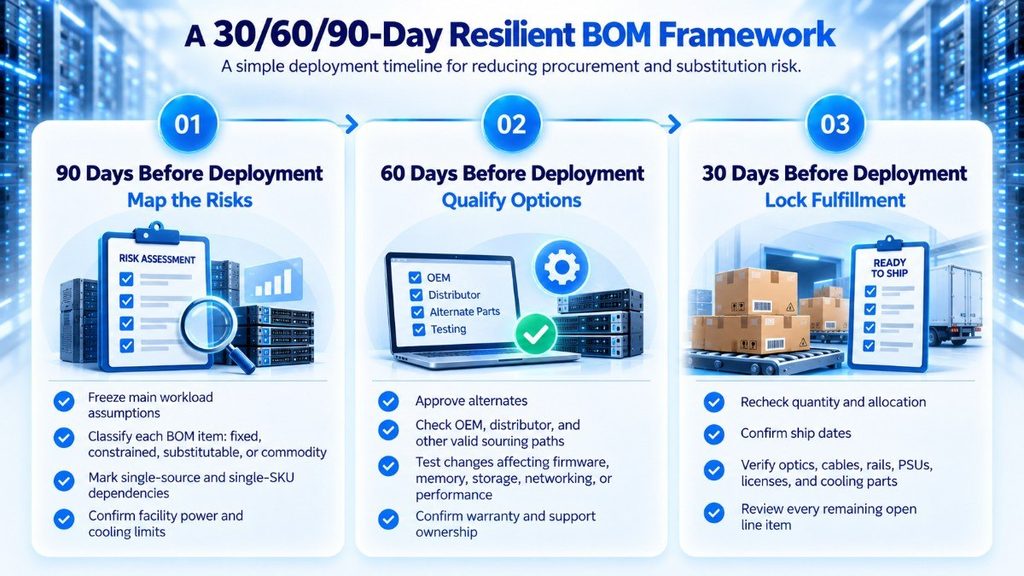
90 Days Before Deployment: Map the Risks
Freeze the main workload assumptions.
Classify every BOM item as fixed, constrained, substitutable, or commodity. Mark single-source and single-SKU dependencies. Confirm facility power and cooling limits.
60 Days Before Deployment: Qualify Options
Approve alternates.
Check OEM, distributor, and other valid sourcing paths. Test changes that affect firmware, memory, storage, networking, or performance. Confirm warranty and support ownership.
30 Days Before Deployment: Lock Fulfillment
Recheck quantity, allocation, ship dates, optics, cables, rails, PSUs, licenses, and cooling parts.
Ask one question for every remaining open line item:
Can this part stop rack turn-up if it arrives late?
If the answer is yes, it needs an escalation path.
Need a more resilient BOM? Send Catalyst Data Solutions Inc. your exact part numbers and quantities for an alternate-sourcing and availability review.
The Goal: Build a BOM That Can Still Be Deployed
A resilient BOM does not mean accepting whatever hardware is available.
It means defining the technical floor, preferred option, approved alternatives, sourcing paths, and approval rules before the project becomes urgent.
Strong AI infrastructure procurement protects more than purchase price. It protects the deployment date, workload performance, compatibility, support model, and lifecycle value.
The practical goal is simple: design for availability without removing the requirements that make the AI system useful.
FAQs
What information should an AI infrastructure RFQ include?
Use the same part numbers, quantities, required-by dates, condition requirements, warranty terms, shipping destination, and acceptable alternate rules for each supplier. Ask vendors to separate stock on hand from expected inbound supply.
What should we do if a component reaches end-of-sale after design approval?
Check the OEM migration path, support end date, firmware impact, and platform qualification of the replacement. Treat the change as a technical review, not only a purchasing update.
Can BOM supply risk be tracked in an ERP or CMDB?
Yes. Useful fields include criticality, approved alternates, supplier count, lifecycle state, current lead time, last validation date, and responsible owner.
When should security review an alternate component?
Security review is useful when a change affects firmware, secure boot, management interfaces, network controls, encryption, remote administration, or vendor support.
How can teams avoid gaps in support across a multi-vendor AI deployment?
Assign a support owner to each infrastructure layer. Record the provider, contract, SLA, entitlement, and escalation path. This reduces the risk of duplicate coverage in one area and no coverage in another.