


Enterprise AI has moved from experimentation to operations. Today, many organizations are building AI into customer service, analytics, security, software development, and internal automation. That shift changes the conversation from model selection alone to infrastructure readiness, governance, and long-term operational control.
For enterprise teams, the challenge is not simply launching AI. It is building an environment that can support data movement, model development, inference performance, compliance, and future scale without creating unnecessary complexity. That is why HPE AI solutions have become an important option for organizations that want enterprise-grade AI infrastructure with private and hybrid deployment flexibility.
HPE approaches AI as part of a broader edge-to-cloud strategy. Its portfolio spans compute, storage, networking, private cloud, and hybrid cloud operations, giving enterprises a way to design AI environments around their own security, workload, and data requirements. Many organizations that begin evaluating HPE AI platforms quickly find that success depends just as much on infrastructure design as it does on the models themselves.
Key Takeaways
- HPE AI solutions combine compute, storage, networking, and hybrid management for enterprise AI deployment.
- HPE Private Cloud AI supports secure, enterprise-controlled AI in private and hybrid environments.
- GreenLake extends cloud-like operations across on-premises infrastructure for scalable hybrid AI management.
- Successful HPE AI deployments require aligned compute, storage, networking, power, cooling, and data protection.
What Are HPE AI Solutions?
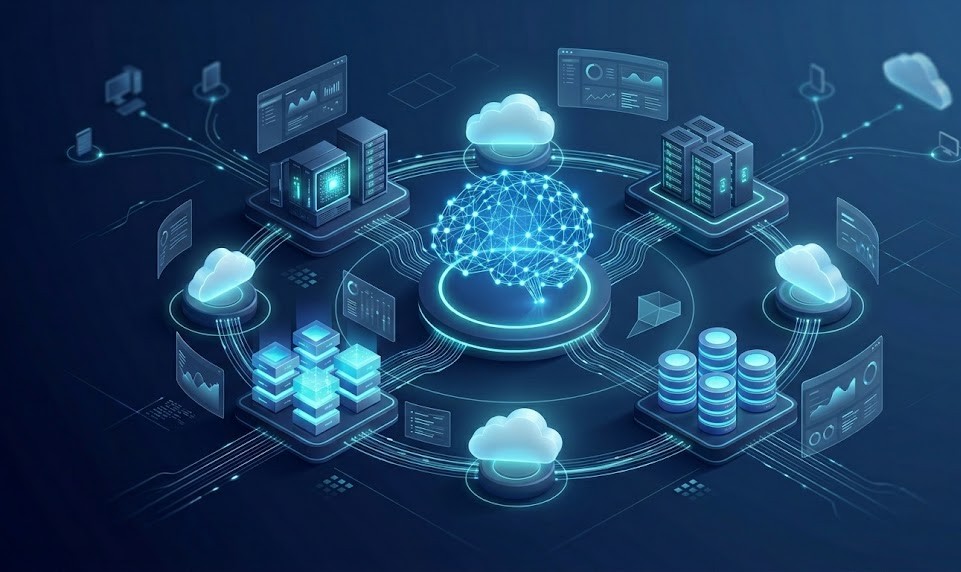
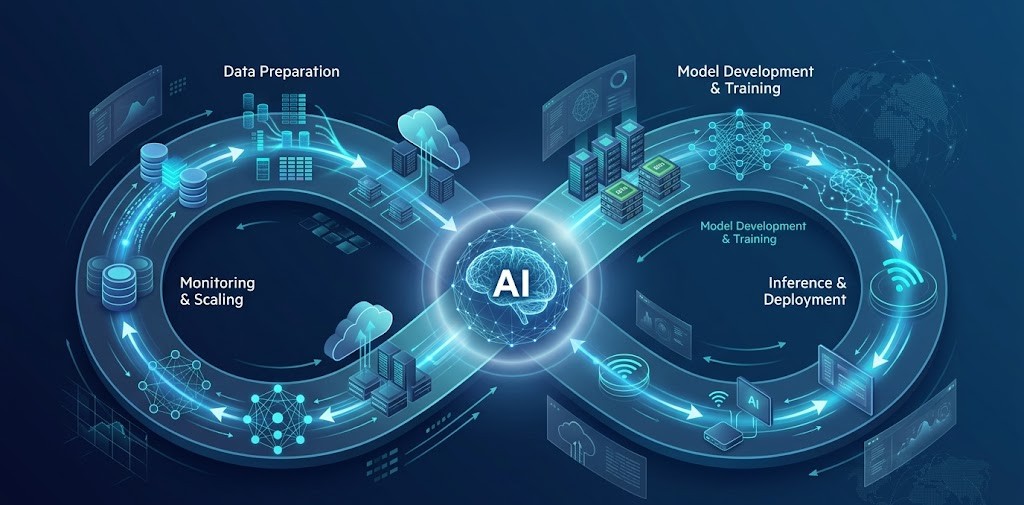
HPE AI solutions refer to the set of infrastructure platforms, software frameworks, and operational services that HPE provides for enterprise AI deployments. These solutions are designed to support the full AI lifecycle, including data preparation, model training, inference, monitoring, and infrastructure management.
Rather than treating AI as a stand-alone cluster or isolated software tool, HPE positions AI as an integrated enterprise capability. That means AI infrastructure must work with existing IT operations, data governance policies, hybrid cloud strategies, and security frameworks.
Enterprise AI in the HPE Ecosystem
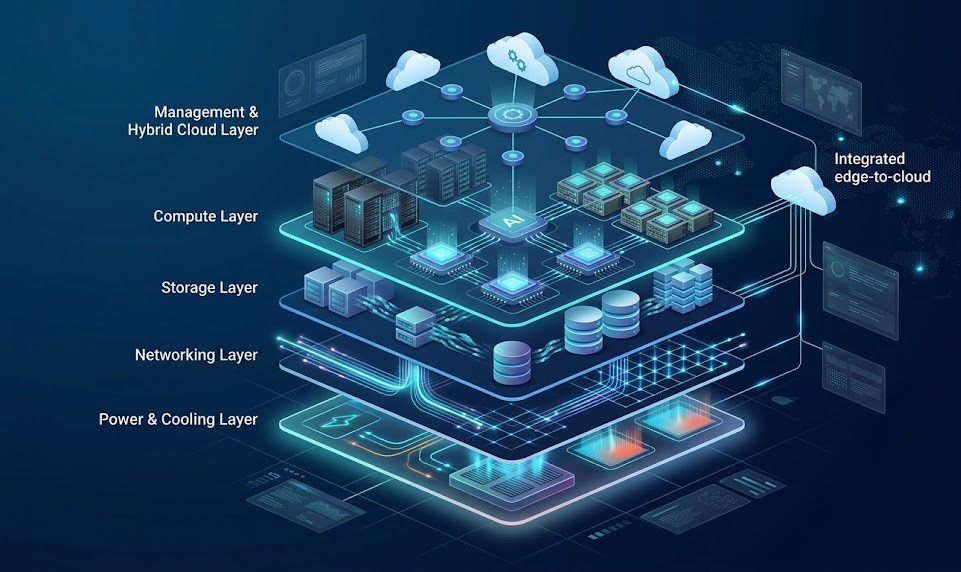
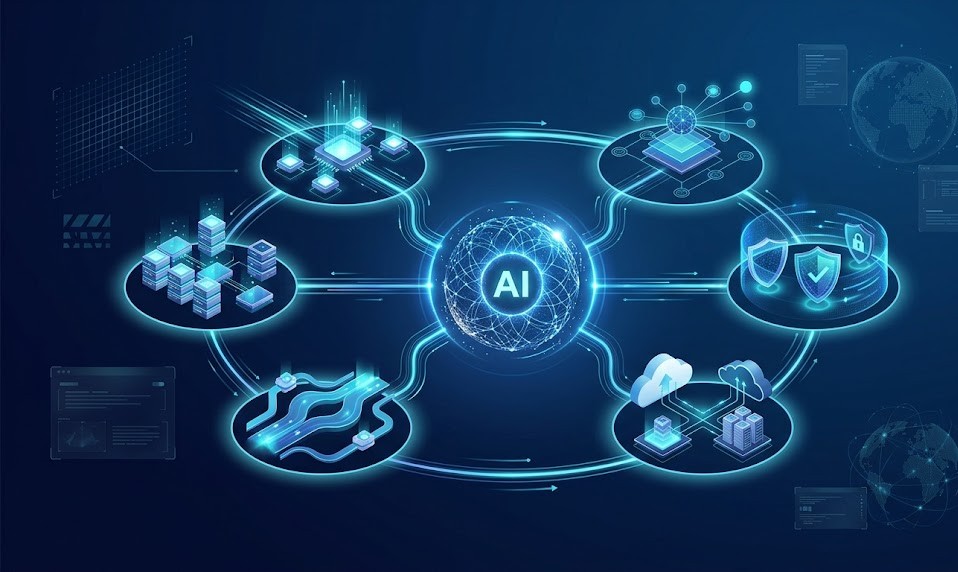
Within the HPE ecosystem, enterprise AI sits across multiple connected layers. HPE provides the compute resources needed for training and inference, storage for high-performance data access, networking for low-latency communication, and management tools for operating AI across on-premises and hybrid environments.
This model is especially useful for enterprises that do not want to separate AI from the rest of their infrastructure strategy. In practice, AI workloads often depend on the same operational disciplines as other core platforms, including uptime planning, security controls, backup strategy, and capacity forecasting.
Core HPE AI Solution Categories
HPE AI solutions usually fall into a few major categories:
- AI compute platforms for training and inference
- Private AI platforms for secure enterprise deployment
- Hybrid cloud operating environments
- Enterprise storage for AI data pipelines
- Networking and infrastructure support for scale and performance
These categories allow organizations to build a complete environment rather than solve one layer at a time.
How HPE Connects AI with Cloud Infrastructure
HPE connects AI with cloud infrastructure through a hybrid operating model. Instead of forcing all AI workloads into a public cloud or keeping everything locked in a traditional data center model, HPE enables organizations to place workloads where they make the most operational and business sense.
That is why AI planning often overlaps with hybrid cloud design. Enterprises may keep sensitive data and critical inference workloads in private environments while using cloud-connected resources for expansion, bursting, or distributed operations.
Why HPE Matters for Enterprise AI and Hybrid Cloud
AI adoption is already mainstream inside large organizations. McKinsey reported that 78% of respondents say their organizations use AI in at least one business function, which shows how quickly enterprise AI has become part of normal operations rather than a niche initiative.
That matters because enterprise AI requires infrastructure choices that can support real use, not just lab testing. HPE matters in this space because it brings together hardware, private cloud architecture, and hybrid operations under one enterprise-focused strategy.
Private AI, Hybrid AI, and Enterprise Control
Private AI is important for organizations that need tighter control over data, access, and model behavior. Hybrid AI becomes important when enterprises want to combine on-premises governance with cloud flexibility.
HPE is relevant here because it supports both approaches. That gives organizations the freedom to design around regulation, latency, internal security standards, or data residency requirements without committing to a one-size-fits-all architecture.
HPE’s Edge-to-Cloud Approach
HPE’s edge-to-cloud model is built around managing applications and data across distributed environments. For AI, that is useful because enterprise data is rarely stored in one place. It may live in data centers, branch locations, private clouds, backup environments, and cloud platforms.
A connected operating model helps reduce fragmentation. It also makes it easier to scale AI without redesigning every supporting infrastructure layer from the ground up.
Governance, Security, and Data Control
Governance is one of the biggest reasons organizations evaluate HPE for AI. Enterprise teams need to know where data is stored, who can access it, how models are used, and how infrastructure is managed over time.
Private and hybrid designs can support those goals more effectively than a cloud-only approach in many environments. Network segmentation, controlled storage access, internal identity systems, and audit policies all become easier to align when the infrastructure is designed with enterprise control in mind.
Key HPE AI Products and Platforms
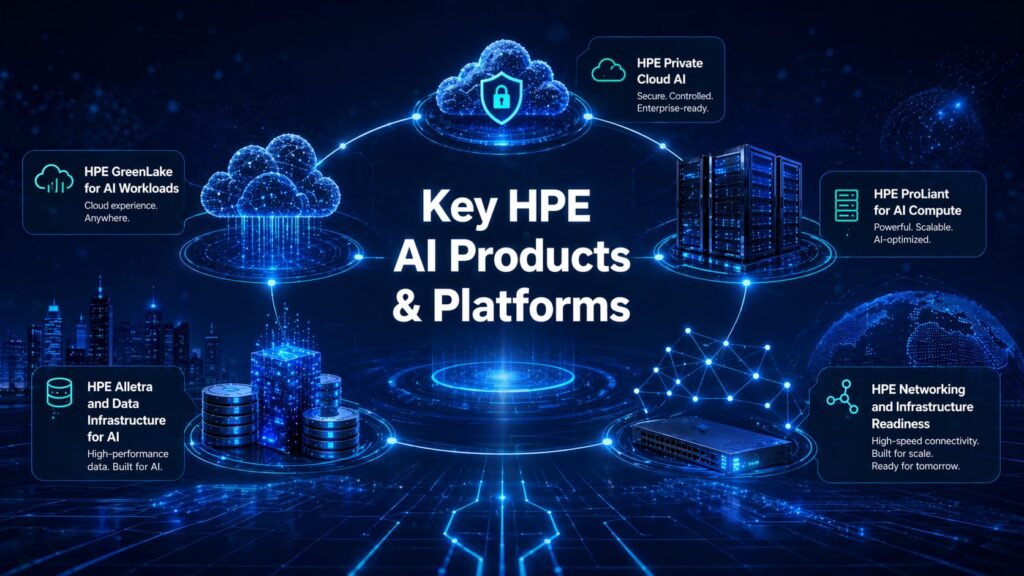
HPE Private Cloud AI
HPE Private Cloud AI is an integrated platform designed to simplify private AI deployment. It combines validated infrastructure and software components so organizations can move faster from planning to production.
This approach is useful for enterprises that want a more structured path to AI deployment without assembling every layer independently.
HPE GreenLake for AI Workloads
HPE GreenLake brings a cloud operating experience to enterprise-owned infrastructure. For AI workloads, that means organizations can manage resources with more flexibility while still maintaining stronger control over placement, policies, and operations.
GreenLake is important when enterprises want cloud-like simplicity without giving up private or hybrid deployment options.
HPE ProLiant for AI Compute
HPE ProLiant systems play a key role in AI compute. They support the processing requirements behind training, fine-tuning, inference, and related enterprise workloads.
For organizations planning AI compute environments, the server layer must align with accelerator selection, workload density, and rack-level readiness. That is why early-stage GPU deployment planning often influences the entire infrastructure design.
HPE Alletra and Data Infrastructure for AI
Storage matters because AI performance depends heavily on how quickly data can be accessed, moved, and managed. HPE Alletra supports that layer by providing enterprise data infrastructure designed for performance, scale, and operational simplicity.
Strong storage architecture becomes even more important when multiple teams, models, and pipelines rely on the same environment.
HPE Networking and Infrastructure Readiness
AI workloads create demanding east-west traffic patterns, large data transfers, and strict latency requirements. That makes networking readiness essential. HPE environments are often supported by an Ethernet fabric strategy built around Arista for high-performance connectivity, while physical readiness may depend on Vertiv or APC by Schneider Electric for power and rack support.
HPE AI Solutions Portfolio Overview
| Solution Area | Primary HPE Offering | Enterprise Role | Contextual Pairing |
| Private AI platform | HPE Private Cloud AI | Secure and integrated AI deployment | Microsoft Azure |
| Hybrid operations | HPE GreenLake | Unified cloud-like management | Microsoft Azure |
| Compute | HPE ProLiant | Training and inference performance | Arista |
| Storage | HPE Alletra | AI data access and persistence | Arista |
| Networking | HPE Networking | Low-latency traffic flow | Arista |
| Physical infrastructure | Power and facility ecosystem | Rack, power, and protection readiness | Vertiv / APC by Schneider Electric |
HPE Private Cloud AI Explained
What It Is
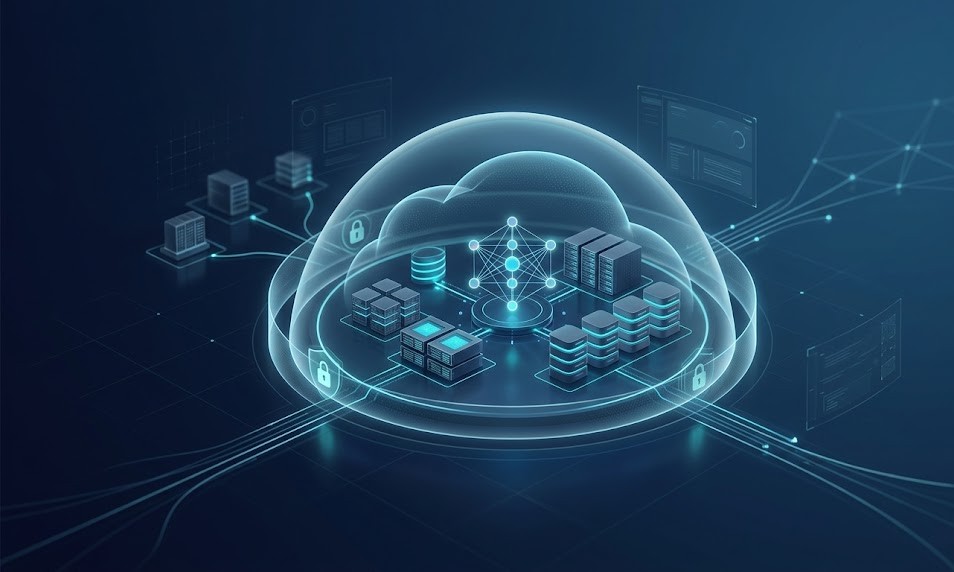
HPE Private Cloud AI is a pre-integrated private AI platform designed for enterprise deployment. It is intended to reduce the complexity of building AI-ready environments by combining core infrastructure elements into a more validated design.
Core Components
Its core components typically include:
- AI-ready compute
- High-performance storage
- Enterprise networking
- Platform software and orchestration
- Operational tooling for deployment and management
That structure gives organizations a more direct path to production readiness.
Deployment Model
The deployment model centers on private cloud principles. Infrastructure is deployed in an enterprise-controlled environment, while operations can still fit into broader hybrid cloud strategies.
This is especially useful for teams that need stronger internal control but still want operational flexibility.
Best-Fit Enterprise Use Cases
HPE Private Cloud AI is often a strong fit for:
- Internal generative AI tools
- Regulated data environments
- Enterprise knowledge systems
- Departmental AI platforms
- AI workloads requiring predictable performance
It is especially effective when governance and operational consistency matter as much as raw compute scale.
How HPE Supports the Enterprise AI Lifecycle
Data Preparation and Access
The AI lifecycle starts with data. That means storage throughput, data governance, access controls, and data location all matter early.
Organizations often underestimate how much infrastructure planning is required before a model ever runs. Data staging, storage structure, and access performance can directly affect AI project timelines.
Model Development and Training
HPE supports model development and training through enterprise compute platforms and integrated AI environments. This helps teams run experiments, fine-tune models, and build production-ready workflows in controlled infrastructure.
In some cases, specialized accelerator configurations may also shape platform selection, especially where dense training workloads are involved.
Inference and Production Deployment
Inference is where business value is usually realized, but it is also where operational weaknesses become visible. Production inference requires stable compute, strong network paths, consistent storage access, and security controls that match enterprise policy.
This is also where AI network design becomes operationally important. Poor network planning can reduce GPU efficiency and create bottlenecks long before compute capacity is fully used.
Monitoring, Scaling, and Operations
Once AI is in production, teams need visibility into utilization, growth, capacity, and infrastructure health. HPE’s hybrid operating model helps support ongoing operations through centralized management and lifecycle flexibility.
That makes scaling more manageable as workloads expand from pilot environments to business-wide platforms.
HPE AI Infrastructure Architecture
Compute Layer
The compute layer handles training, tuning, and inference execution. This is where HPE ProLiant systems and AI-optimized server designs play their main role.
Compute decisions should reflect model size, concurrency, expected utilization, and accelerator compatibility. In some environments, accelerator planning may include options like NVIDIA H100 PCIe 900-21010-0000-000 or NVIDIA H100 SXM5 GPU.
Storage Layer
The storage layer supports training data, model artifacts, checkpoints, and inference datasets. Performance here influences how efficiently compute resources can be used.
HPE Alletra supports this layer by providing scalable enterprise storage designed for modern data-intensive environments.
Networking Layer
The networking layer connects computers, storage, and users. It must support fast east-west traffic, predictable throughput, and enough resilience for enterprise operations.
Arista is a practical contextual fit here because AI environments often rely on high-performance Ethernet architectures that can support dense data movement without introducing unnecessary complexity.
Power, Cooling, and Physical Infrastructure
Power and cooling are often overlooked during early AI planning. Dense AI systems place more pressure on racks, UPS capacity, thermal management, and facility design than traditional enterprise workloads.
Vertiv is commonly aligned to high-density cooling and power support, while APC by Schneider Electric fits rack-level distribution and protection requirements. This becomes even more important in environments using hardware like NVIDIA H100 8x80GB SXM.
Management and Hybrid Cloud Layer
The management layer ties infrastructure together. HPE GreenLake supports visibility, lifecycle operations, and service-based management across hybrid environments.
Where cloud integration is needed, Microsoft Azure is a logical pairing for extending workloads, connecting services, or supporting broader hybrid operating models.
HPE AI Infrastructure Layers and Roles
| Infrastructure Layer | Role in AI Environment | Primary HPE Focus | Contextual Complement |
| Compute | Runs training and inference | HPE ProLiant | Microsoft Azure |
| Storage | Delivers data to workloads | HPE Alletra | Arista |
| Networking | Moves traffic across the AI fabric | HPE Networking | Arista |
| Power | Supports runtime continuity | Facility integration | APC by Schneider Electric |
| Cooling | Maintains thermal stability | Site readiness planning | Vertiv |
| Management | Governs hybrid operations | HPE GreenLake | Microsoft Azure |
HPE AI Solutions for Enterprise Use Cases
Generative AI Workloads
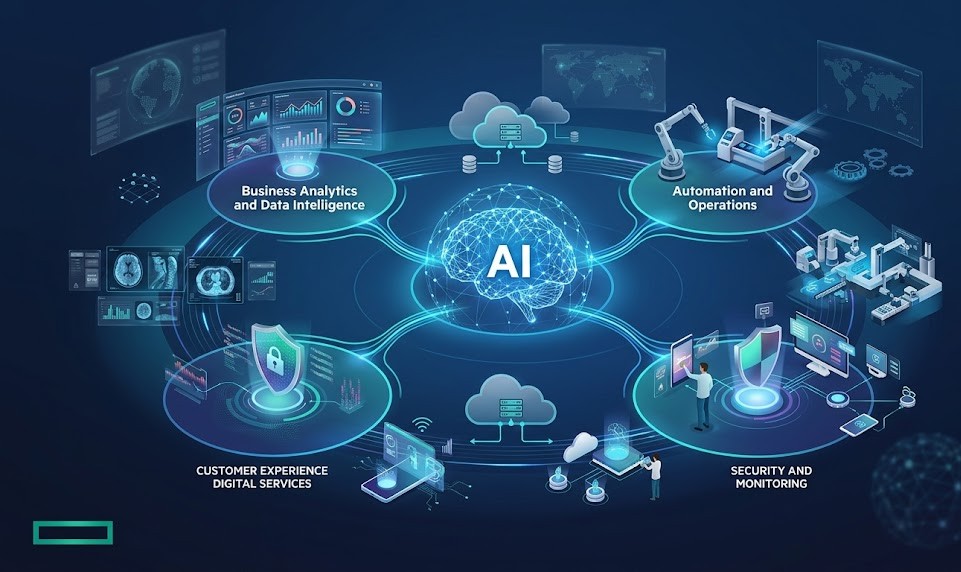
Generative AI workloads often require controlled access to enterprise data, predictable performance, and tighter security oversight. HPE is well suited for internal copilots, retrieval-based knowledge tools, and enterprise content intelligence platforms.
AI for Analytics and Automation
Not every AI deployment is a large model training environment. Many organizations use AI for forecasting, analytics, automation, anomaly detection, and operational support. HPE’s flexible infrastructure model can support those use cases without forcing an oversized architecture.
Industry-Specific Enterprise AI Deployments
Industries with stronger governance needs often benefit from private and hybrid deployment models. Healthcare, financial services, public sector, and manufacturing organizations may need more control over data access, retention, and infrastructure placement.
That makes HPE a strong option for enterprises where compliance and operations must move together.
Hybrid and Private AI Environments
Hybrid and private AI environments are often the most realistic path for enterprises. Some workloads need to remain close to enterprise data. Others benefit from cloud extension or external services.
HPE supports that balance by enabling organizations to choose workload placement based on business and technical requirements, not just convenience.
Benefits of HPE AI Solutions for Enterprises
AI infrastructure is now a strategic investment category. IDC has projected that enterprises worldwide are expected to invest $307 billion in AI solutions in 2025, which shows how seriously organizations are treating AI readiness and long-term deployment planning.
Faster Deployment and Time to Value
Integrated platforms and validated architectures reduce deployment delays. That allows teams to spend less time assembling infrastructure and more time moving workloads into production.
Data Privacy and Compliance Support
Private and hybrid models help support data control, governance alignment, and compliance planning. For many enterprises, this is a deciding factor.
Scalability Across Hybrid Infrastructure
HPE supports expansion across private and hybrid environments, which helps organizations scale without discarding existing infrastructure strategy.
Operational Simplicity and Lifecycle Flexibility
A unified operational model can reduce fragmentation between infrastructure teams, cloud teams, and AI teams. That becomes more valuable as environments grow.
Private AI vs Hybrid AI vs Public Cloud AI Comparison
| Deployment Model | Best Fit | Main Advantage | Main Consideration |
| Private AI | Sensitive data and strict control | Governance and predictable placement | Higher site planning responsibility |
| Hybrid AI | Mixed workload placement | Flexibility across environments | Greater architecture coordination |
| Public Cloud AI | Rapid access and elastic scaling | Speed and service breadth | Reduced direct infrastructure control |
How to Choose the Right HPE AI Solution
Questions to Ask Before Infrastructure Selection
Before selecting infrastructure, ask:
- What workloads will run first?
- Which data sets must remain private?
- How much performance headroom is required?
- Is the current network ready for AI traffic?
- Can the facility support power and thermal density?
- What recovery requirements apply to AI data and services?
These questions help prevent underbuilt or mismatched environments.
Private Cloud vs Hybrid Cloud AI Decisions
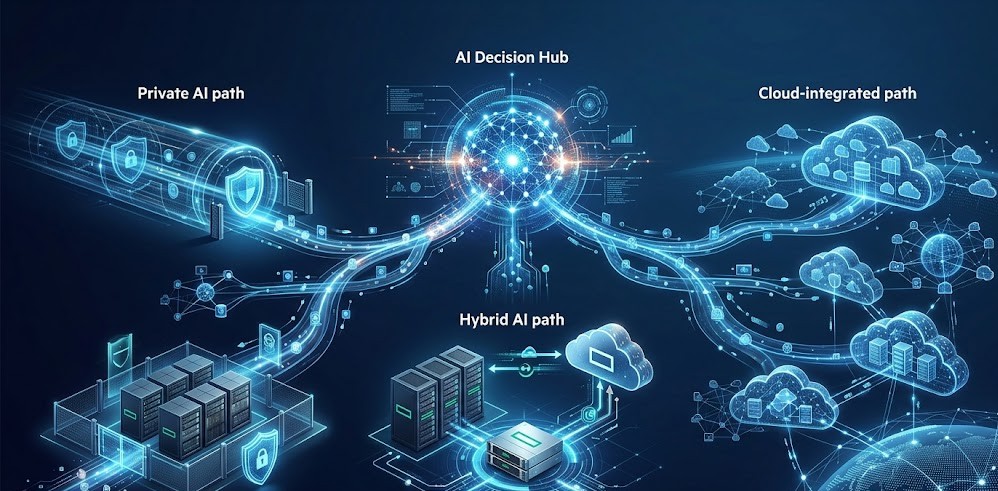
Private cloud AI makes sense when governance, security, and data locality are priorities. Hybrid AI is usually the better fit when organizations need a blend of control and cloud-connected flexibility.
The best decision depends on workload placement, compliance requirements, and operational maturity.
How to Align Infrastructure with Workload Needs
Infrastructure should match workload behavior. Training-heavy environments need denser compute and faster data movement. Inference-heavy environments often need consistent availability, lower latency, and simpler operational scale.
That is why solution design should begin with the workload, not with hardware in isolation.
Implementation Considerations for HPE AI Environments
Integration with Existing IT Infrastructure
Most organizations must integrate AI into existing identity systems, backup strategies, security controls, and operational processes. Smooth integration reduces deployment friction and improves adoption.
Network, Storage, and Rack Readiness
AI infrastructure only performs as well as its supporting environment. Storage paths, rack layouts, cable planning, and network design all affect final outcomes.
Power, Cooling, and Capacity Planning
Power and cooling should be addressed early. Teams evaluating dense AI environments often benefit from reviewing cooling infrastructure choices before finalizing rack-level deployment assumptions.
Data Protection and Recovery Planning
AI environments need protection for training data, model outputs, configurations, and operational services. Recovery planning should be part of infrastructure design from the beginning, not something added later.
Conclusion
HPE AI solutions give enterprises a structured way to build AI environments across private and hybrid infrastructure. Instead of focusing only on compute, HPE supports the broader operational picture, including storage, networking, governance, and lifecycle management.
That makes HPE a strong fit for organizations that want enterprise AI environments built for real production use. The right deployment model will depend on workload needs, data sensitivity, facility readiness, and cloud strategy, but the core principle remains the same: successful AI depends on a full infrastructure design, not just accelerator capacity.
Need Help Building the Right HPE AI Environment?
Catalyst Data Solutions Inc. supports organizations with planning, sourcing, and deploying HPE AI and cloud infrastructure for private and hybrid enterprise environments.
FAQs
What are HPE AI solutions for enterprise AI?
HPE AI solutions are HPE’s enterprise platforms for AI compute, storage, networking, private cloud, and hybrid operations. They support the infrastructure and management needs behind enterprise AI deployment.
What is HPE Private Cloud AI?
HPE Private Cloud AI is an integrated private AI platform designed to help organizations deploy and manage AI in a controlled enterprise environment with less integration complexity.
How does HPE support hybrid cloud AI infrastructure?
HPE supports hybrid cloud AI infrastructure through GreenLake and its broader edge-to-cloud operating model, allowing organizations to manage AI workloads across private and cloud-connected environments.
What infrastructure components are required for HPE AI deployments?
Most HPE AI deployments require compute, storage, networking, management tooling, power planning, cooling readiness, and data protection strategy.
How do organizations choose between HPE private AI and public cloud AI environments?
Organizations usually choose HPE private AI when they need tighter governance, data control, and predictable infrastructure placement. Public cloud environments are often chosen for elasticity and speed, while hybrid models combine both approaches.